Most service businesses run 3–5 disconnected marketing tools and wonder why growth is inconsistent. This is the complete guide to building a digital growth system that generates qualified leads without depending on referrals or luck.
The Complete Guide to Building a Digital Growth System for Service Businesses
Most service businesses don't have a marketing problem. They have a systems problem.
They're running Meta ads that send traffic to a homepage that wasn't built to convert. They have a CRM with 400 contacts and no follow-up sequence. They've paid for a website that looks good but does nothing to qualify leads. And they have an analytics dashboard they don't look at because they don't know which numbers matter.
None of these are bad tools or bad vendors. They're good components that were never connected into a system.
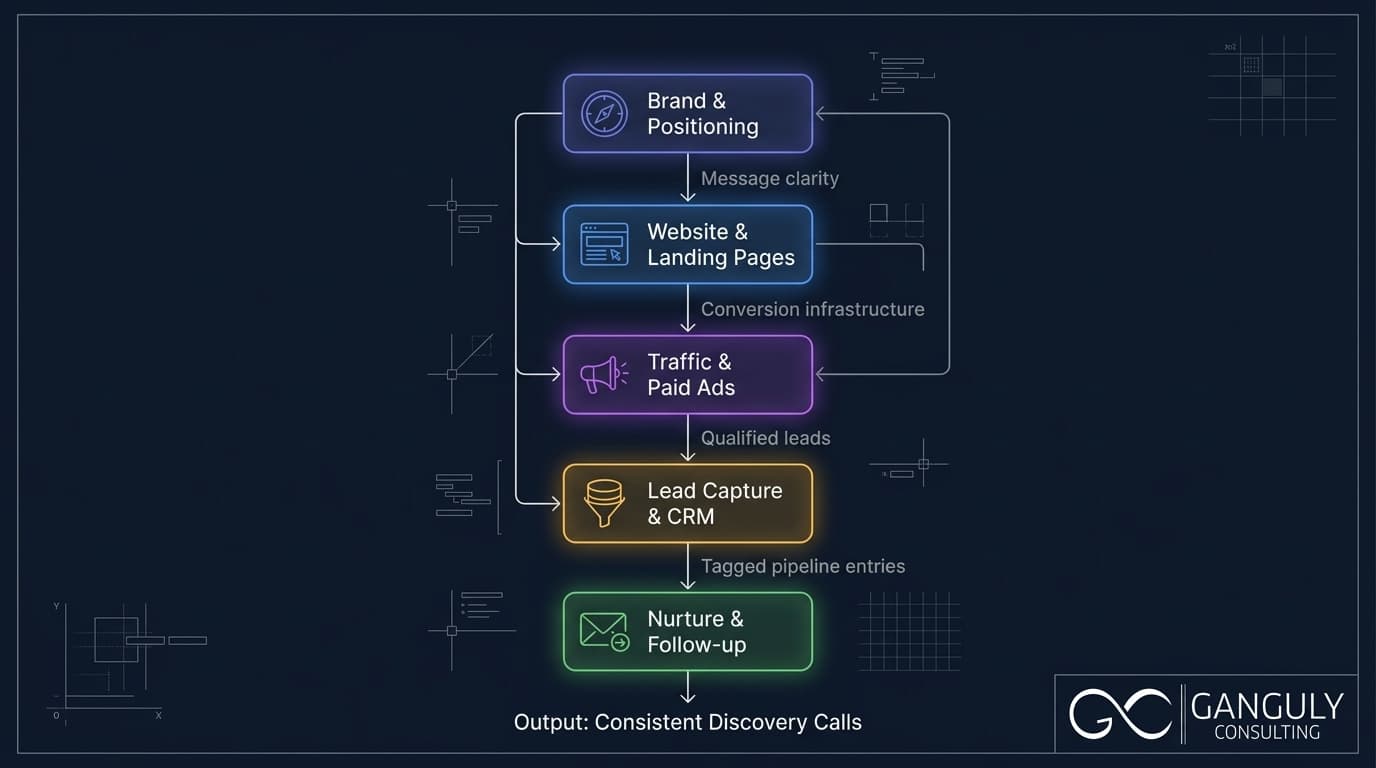
A digital growth system changes that. It's not a campaign, a single tool, or a hiring decision. It's a connected infrastructure — a set of components that work together to generate qualified leads consistently, convert them predictably, and give you visibility into what's working. When it's built correctly, it runs largely without you. When any piece is missing or disconnected, the whole thing leaks.
This guide covers what a digital growth system is, why service businesses specifically need one, what its five layers are, how to build it from scratch, and what it looks like when it's working. It's the most comprehensive thing we've written, and it's designed to serve as your strategic reference throughout the build.
Key Takeaways
- 83% of businesses say marketing silos block strategy alignment — but the root cause is structural, not strategic (Amra and Elma, 2025)
- Marketing automation — a core component of any digital growth system — delivers 544% ROI over three years (Thunderbit, 2026)
- CRM connected to your ad and website data boosts lead conversions by up to 300% (DemandSage, 2026)
- Only 21% of marketing leaders can measure the ROI of their marketing investment (ResearchAndMetric, 2025)
- A complete digital growth system has five layers: Brand & Positioning, Website & Landing Pages, Traffic & Paid Ads, Lead Capture & CRM, and Nurture & Follow-up
What Is a Digital Growth System?
A digital growth system is the integrated infrastructure a service business uses to attract qualified prospects, convert them into leads, and move them toward a buying decision — automatically and consistently.
The word "system" is doing meaningful work in that definition. A system has components that depend on each other. A change in one part affects the others. The output of one layer becomes the input of the next. And when every component is connected, the whole performs better than the sum of its parts.
This is fundamentally different from how most service businesses approach marketing. The typical setup looks like this:
- A website built by a designer who optimized for aesthetics
- Ads managed by a media buyer who optimizes for clicks
- A CRM that was set up during an optimistic afternoon two years ago
- An email list that gets a newsletter when someone remembers to write one
- Analytics nobody looks at because the numbers don't mean anything actionable
Each of these represents a vendor relationship, not a systems decision. And that's the core problem: vendors optimize for their piece, not for the handoffs. The handoffs are where leads are lost.
A digital growth system is what happens when you stop optimizing each piece in isolation and start designing the handoffs deliberately.
Our observation: When we audit a service business's digital setup, the gap between what they're spending and what they're earning from digital channels is almost never explained by bad ads or a bad website. It's explained by the absence of a deliberate handoff between the ad and the landing page, between the form submission and the CRM, and between the CRM entry and the follow-up sequence. The pieces exist. The system doesn't.
Read more: Why Your Website, Ads, and CRM Need to Work as One System
Why Service Businesses Need a System (Not Just Campaigns)
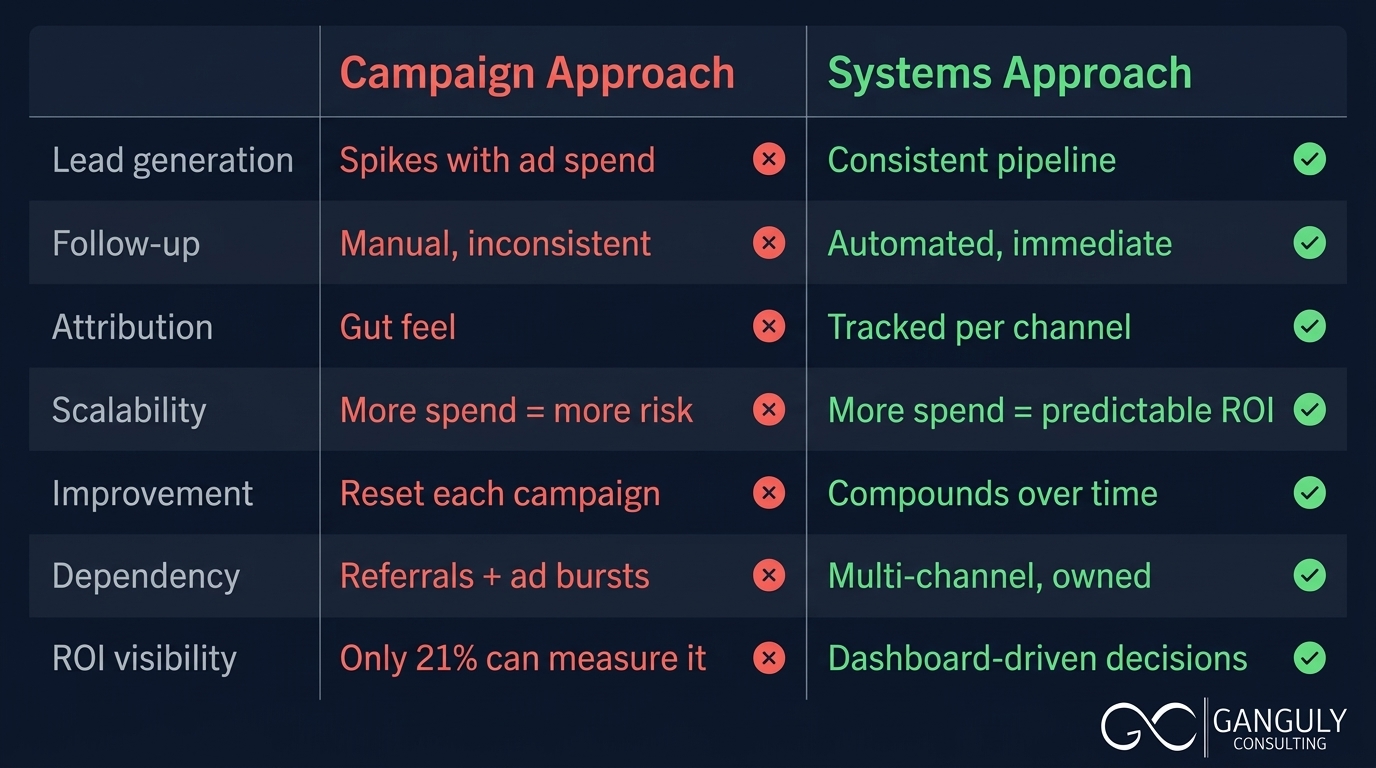
A product business can get away with campaigns. Run a promotion, generate revenue, wind it down, run another. Each campaign is relatively self-contained because the product sells to anyone who wants it, the transaction is immediate, and repeat purchases can be driven by loyalty programs or retargeting.
Service businesses don't work that way. The sales cycle is longer. Trust is a prerequisite. The value of a single client relationship often spans years, not transactions. And the lead quality — the fit between the prospect and the service — matters more than the lead volume.
All of this means that a campaign mentality — run ads, get leads, close what you can, stop when the budget runs out — produces inconsistent, unpredictable growth. You're perpetually refilling a leaky pipeline rather than building something that compounds.
A digital growth system produces different results because it works differently:
It converts leads already in the pipeline. Most service businesses are sitting on 6–18 months of leads that went cold because there was no follow-up sequence. A system doesn't let those expire — it nurtures them until they're ready.
It improves without requiring more spend. Every campaign gives you data on what works. A system captures that data, applies it to the next campaign, and improves conversion rates over time. Your CPL drops. Your close rate increases. The same budget produces more.
It runs without daily attention. Once the automations are set up — form to CRM, CRM to email sequence, email sequence to booking — the pipeline moves without requiring manual action for every lead. You handle conversations. The system handles volume.
It tells you what's working. With proper attribution across your ads, landing page, and CRM, you know which campaign generated which lead and what happened to them. That visibility is what separates founders who scale confidently from those who guess.
68% of SMBs plan to increase their marketing budgets in 2026 (Constant Contact / MediaPost). Most of them will invest in more campaigns before they invest in building the system. The ones who build the system first will outperform those who don't — at every budget level.
Read more: The 5 Layers of a Digital Growth System Every Service Business Needs
The 5 Layers of a Digital Growth System
Every digital growth system has five layers. Each layer has a specific function. Each layer's output feeds the next. When all five are present and connected, the system works. When any layer is missing or disconnected, the whole thing underperforms.
Layer 1: Brand & Positioning
Brand and positioning is the foundation layer. It answers the question every prospect asks — consciously or not — within the first few seconds of encountering your business: Is this for me?
Positioning isn't a tagline. It's a set of deliberate choices about who you serve, what problem you solve, and why you — specifically — are the right choice. For a service business, positioning determines everything downstream: which audience you target with ads, what message you put on your landing page, how you write your follow-up emails, and what kind of clients you attract.
Most service businesses have vague positioning. "We help businesses grow." "We provide high-quality [service]." This kind of copy passes no information to a prospect. It doesn't tell them who you serve, what their problem is, or what change you produce. It forces the prospect to do interpretive work — and most won't bother.
Strong positioning is specific, exclusive, and outcome-oriented: "We build integrated digital growth systems for service businesses generating $500K–$5M in annual revenue who are tired of inconsistent lead flow." Every word is doing work.
What Layer 1 produces: Message clarity that makes every downstream layer — ads, landing pages, emails — more effective. Weak positioning is a tax on every other marketing dollar you spend.
Read more: The Trust Architecture: 7 Elements That Make Premium Clients Trust You Online
Layer 2: Website & Landing Pages
Layer 2 is your conversion infrastructure. It's where attention becomes action.
Your main website serves awareness and credibility. A prospect who hears about you, gets referred to you, or finds you through search should be able to understand what you do, who you serve, and why you're credible in under 60 seconds.
Your landing pages serve conversion. A landing page exists for one audience, one campaign, and one action. It has no navigation, no distractions, and one clear offer. When a prospect clicks your Meta ad, they should land on a page that mirrors the exact promise the ad made — same headline concept, same outcome focus, one form.
The most common failure in this layer is using the homepage as the landing page for paid ads. The homepage is built for multiple audiences. A landing page is built for one specific intent. The difference in conversion rate between the two is typically 3–6x in favor of the dedicated landing page.
Only 40% of SMBs have a dedicated business website (BrightLocal, 2025) — and far fewer have properly built landing pages for their paid campaigns. This is one of the highest-leverage gaps to close.
What Layer 2 produces: Qualified form submissions and booking requests, with source data attached, ready to enter the CRM.
Read more: Why Your Website Isn't Generating Leads (And It's Probably Not What You Think)
Layer 3: Traffic & Paid Ads
Layer 3 is how you introduce the system to people who don't know you yet. Paid ads are the most predictable, scalable way to do this — but only when they're connected to Layer 2 and Layer 4.
Meta ads are the entry point for most service businesses. The targeting capabilities — by interest, by behavior, by lookalike audience — make it possible to put a specific message in front of a specific audience at scale. The average CPL for Meta lead gen campaigns across industries is $27.66 (WordStream, 2025). For service businesses with a well-built landing page and connected CRM, this number becomes more meaningful — because you can see what each lead turned into.
But ads without the rest of the system are a liability. You're paying for attention that has nowhere to go. Without a landing page optimized for your ad's specific message, you lose 60–80% of the traffic at the first step. Without a CRM to capture the lead and trigger follow-up, the leads that do convert go cold. Without analytics, you have no idea which campaigns are worth continuing.
Multi-channel integrated campaigns — ads connected to landing pages connected to CRM — achieve 31% lower cost per lead than siloed, single-channel outreach (Sopro, 2025). The 31% reduction isn't magic. It's what happens when you stop losing leads at the handoffs.
What Layer 3 produces: Targeted traffic at a known cost, flowing into a landing page designed to convert it.
Read more: Meta Ads + Landing Page + CRM: The Lead Gen Stack That Actually Works
Layer 4: Lead Capture & CRM
Layer 4 is the operating core of the system. It's where leads go from anonymous website visitors to named, contextualized prospects in a managed pipeline.
When a prospect fills out a form on your landing page, four things need to happen automatically:
- A CRM contact is created with source data (which ad, which campaign, which audience)
- A confirmation email is sent within 60 seconds
- The lead is assigned a pipeline stage
- A nurture sequence begins
Most service businesses get step one wrong — form submissions land in an email inbox, not a CRM. Without CRM capture, you have no source data, no pipeline visibility, and no trigger for automation.
CRM use connected to ad and website data boosts lead conversions by up to 300% (DemandSage, 2026). That number doesn't come from using a CRM as a contact list. It comes from using it as a system — where every lead has context, every stage is tracked, and every action triggers the next step automatically.
What Layer 4 produces: A managed pipeline of named prospects with source data, stage tracking, and automated follow-up triggered.
Read more: How to Build a Lead Generation System That Doesn't Depend on Referrals
Layer 5: Nurture & Follow-Up
Layer 5 is where the pipeline converts. It's the layer most service businesses skip entirely — and it's the most expensive gap to leave unfilled.
65% of businesses have no lead nurturing process in place (Sopro, 2025). They generate leads, respond to the ones who book immediately, and let the rest go cold. The ones who don't book on the first touchpoint — which is most of them — never hear from the business again.
This is backwards. Most prospects who fill out a form are not ready to buy immediately. They're gathering information, comparing options, building trust. The businesses that stay in front of them — with consistent, valuable, relevant follow-up — are the ones that earn the eventual booking.
A basic nurture sequence for a service business looks like this:
- Email 1 (Day 0, instant): Confirmation + one piece of immediate value
- Email 2 (Day 1): Reframe the problem — your perspective on why they're stuck
- Email 3 (Day 3): Social proof — a specific client result, no embellishment
- Email 4 (Day 5): Soft CTA — describe what the next step looks like, with a booking link
That's it. Four emails over five days. Marketing automation at this level delivers a 544% ROI over three years and generates 80% more leads while seeing 77% higher conversion rates (Thunderbit, 2026).
What Layer 5 produces: Booked discovery calls from prospects who weren't ready on day one.
Read more: Why 65% of Businesses Have No Lead Nurturing Process (And How to Build One)
How the 5 Layers Work Together
Understanding the layers individually is useful. Understanding how they connect is what actually matters.
Here's how a lead flows through a working digital growth system, from first impression to booked call:
-
A prospect sees your Meta ad. The ad is targeted to a specific audience profile — let's say founders of professional services firms with 5–25 employees in three metro areas. The copy speaks directly to their problem: inconsistent lead flow, too dependent on referrals. They click because the message resonates.
-
They land on a dedicated landing page. The page mirrors the ad's message. Same problem. Same promise. One form — name, email, company size, biggest challenge. No navigation, no "About Us" link, no way to wander. They fill in the form.
-
The form triggers four things simultaneously. A CRM contact is created with the source ad and campaign tagged. A confirmation email lands in their inbox within 60 seconds. They're assigned a pipeline stage: "New Lead — Sequence Started." And the four-email nurture sequence begins.
-
Over the next five days, they receive four emails. The first is a confirmation with an immediately useful resource. The second challenges how they've been thinking about their lead flow problem. The third shares a specific result from a client with a similar profile. The fourth describes what a 30-minute discovery call looks like and includes a booking link.
-
They book a call. Not because you called them five times. Because you stayed in front of them with relevant, useful content while they were making a decision. The booking comes from the system, not from manual follow-up.
-
You review the attribution data. You can see that this lead came from Campaign X, Ad Creative Y, on Day 12 of the campaign. You can see their email open history, their pipeline stage, and when they booked. That data improves the next campaign.
That's the full cycle. Every step is deliberate. Every handoff is designed. No leads fall through the gaps because there are no gaps — only connections.
How to Build Your Digital Growth System: Phase by Phase
You don't build all five layers at once. You build them in order, each one enabling the next.
Phase 1: Clarify Your Positioning (Week 1)
Before anything else, get clear on three things:
- Who you serve exactly (not "small businesses" — specific industry, revenue range, geography, or problem profile)
- What outcome you produce (not "we help you grow" — a specific, measurable change)
- Why you specifically (not a generic agency pitch — your methodology, your approach, your track record)
Write a positioning statement you'd be comfortable putting on a billboard in your target city. If you can't explain what you do in one sentence without industry jargon, your positioning isn't clear enough yet.
This isn't a branding exercise. It's a systems prerequisite. Everything downstream — ad copy, landing page headline, email subject lines — flows from this.
Phase 2: Build the Conversion Infrastructure (Weeks 2–3)
With clear positioning, build the landing page. One page, for your primary offer, built to convert a specific audience coming from paid traffic.
The page needs:
- A headline that mirrors the problem you defined in positioning
- 3–5 bullet points of specific outcomes or proof points
- A simple form (4–5 fields maximum)
- One CTA (book a call, get an audit, download a guide — pick one)
- No navigation menu
- No links out
Simultaneously, set up your CRM if you don't have one. HubSpot free, GoHighLevel, or ActiveCampaign all work. Connect your form to your CRM with source tracking. Test it — submit the form yourself and confirm the contact appears in your CRM with the source attached.
Phase 3: Build the Nurture Sequence (Week 3–4)
Write four emails before you run a single ad:
- Email 1 (Day 0): Confirmation + value
- Email 2 (Day 1): Reframe the problem
- Email 3 (Day 3): One specific client result
- Email 4 (Day 5): Describe the next step + booking link
Set these to fire automatically from your CRM when a new contact enters the pipeline. Test the sequence by adding yourself as a contact. Confirm all four emails arrive correctly timed.
This sequence is the difference between a lead pipeline and a lead bucket. Leads in a bucket go cold. Leads in a pipeline move.
Phase 4: Launch Paid Traffic (Week 4–5)
With your landing page live and your nurture sequence active, you're ready to drive traffic. Start with a single Meta ads campaign targeting your specific audience profile.
Run one campaign, two ad sets (different audiences), two ad creatives per ad set. Let it run for 14 days before making changes. Track: clicks, landing page conversion rate (form submissions ÷ clicks), and leads entered to CRM.
Do not increase budget until your landing page is converting at 5%+. Adding spend to a page that converts at 2% just means more expensive failures.
Phase 5: Connect Analytics (Week 5–6)
Once leads are flowing, connect visibility. At minimum:
- GA4 on your website and landing page
- UTM parameters on every ad URL
- A simple dashboard in your CRM showing: new leads this week, sequence completion rate, bookings from the sequence
You're tracking three numbers weekly: leads in, conversion rate on landing page, bookings from nurture. That's enough to make decisions.
Only 21% of marketing leaders can accurately measure the ROI of their marketing investment (ResearchAndMetric, 2025). With UTMs and a connected CRM, you will be in that 21%.
Read more: The Real Cost of Siloed Marketing (And How to Fix It)
Common Mistakes That Break the System
Mistake 1: Scaling ad spend before the landing page converts. Every dollar you spend on traffic is only as good as the page it lands on. If your landing page is converting at 2%, doubling the ad budget doubles your losses. Fix the page first.
Mistake 2: Treating CRM as a contact list. A CRM without source tracking and automation is just an expensive spreadsheet. Every lead must have source data, stage tracking, and an automated sequence triggered. The CRM's value is in what it does automatically, not in what it stores passively.
Mistake 3: Writing a nurture sequence that pitches too early. Email 1 and Email 2 in the sequence should not ask for anything. They should give. The CTA belongs in Email 4. Leads that feel sold to in the first 24 hours unsubscribe or mark as spam.
Mistake 4: Building all five layers before launching anything. The system doesn't need to be perfect before it's useful. A basic landing page + CRM + 4-email sequence beats waiting six months to build a complete system. Start with Layer 2, 4, and 5. Add Layers 1 and 3 as you learn.
Mistake 5: Changing too many things at once. When results are weak, resist the temptation to change the ad, the landing page, and the email sequence simultaneously. Change one variable at a time. Otherwise, you don't know which change produced which result, and you can't replicate success.
Read more: The Real Cost of Siloed Marketing (And How to Fix It)
What a Working Digital Growth System Looks Like
A digital growth system that's functioning correctly has specific, observable characteristics:
Consistency. Leads enter the pipeline on a predictable schedule — not as spikes tied to referral bursts or ad campaigns you turned on for a month. The pipeline is always moving.
Visibility. At any point, you can open your CRM and see exactly how many leads are at each stage, where they came from, and what happened to the ones who didn't book. No guessing about what's working.
Compounding. Each month, your CPL drops or your close rate improves — because you're applying what last month's data taught you. The system gets more efficient over time without requiring more manual effort.
Independence. You're not dependent on any single channel, single vendor, or single campaign. The website drives some organic leads. The ads drive paid leads. The nurture sequence converts both. Referrals feed into the same pipeline and get the same follow-up.
Leverage. As the founder, you spend time on discovery calls and client delivery — not manually following up with every lead, manually exporting CRM data, or manually remembering to send the "just checking in" email. The system does that.
This is the state most service business founders want but can't describe clearly. They know their marketing is underperforming. They know they're leaving leads on the table. What they don't have is a framework for fixing it systematically.
That framework is what this guide describes. And building it — even a basic version — is the single highest-leverage investment most service businesses can make in their growth infrastructure.
Frequently Asked Questions
How long does it take to build a digital growth system from scratch?
A minimum viable version — clear positioning, one landing page, a CRM with source tracking, and a four-email nurture sequence — can be built in four to six weeks for most service businesses. The timeline depends almost entirely on how long it takes to write the copy (positioning statement, landing page, email sequence). The technical setup is usually an afternoon's work per layer. A fully integrated system with analytics, multiple ad campaigns, and a refined nurture sequence typically takes three to four months to reach peak performance.
How much does it cost to build and run?
The tool cost for a basic digital growth system is lower than most founders expect. HubSpot's free CRM handles lead capture and basic sequences. A Zapier account (free tier) handles form-to-CRM connections. Calendly or Cal.com (free tiers) handles booking. GA4 is free. The only significant cost is paid ads — and you should start at the minimum viable budget ($1,500–$3,000 per month for Meta) until your landing page conversion rate justifies scaling. The biggest investment is time, not tools.
Do I need a technical team to build this?
No. The tools that power a digital growth system — HubSpot, GoHighLevel, Zapier, Calendly, a basic landing page builder — are built for non-technical users. If you can operate a Google Doc and a spreadsheet, you can build the foundational layers of this system. The landing page is the most technically demanding piece, and platforms like Webflow, Leadpages, or ClickFunnels handle that without code. Where technical help genuinely adds value is in custom integrations between non-standard tools — but you don't need those to start.
Which CRM should I use?
For most service businesses starting out: HubSpot (free tier covers contacts, deals, email sequences, and basic automations), GoHighLevel (best for service businesses wanting an all-in-one system including the landing page builder), or ActiveCampaign (best for businesses prioritizing email automation depth). The right CRM is the one you'll actually use. Pick one and connect it fully before evaluating alternatives. A partially-used enterprise CRM produces worse results than a fully-connected free tool.
Should I build this before or after hiring a marketing agency?
Build it before — or build it alongside any agency you hire. The core problem with agency relationships for service businesses is that they optimize their channel without owning the full system. A media buyer will optimize your ads. They won't build your landing page, connect your CRM, or write your nurture sequence unless that's explicitly in scope. If you hand your digital presence to an agency before building the system, you'll pay for their piece and still wonder why the whole doesn't work. Understand the system first. Then hire specialists to execute specific layers within it.
The System Is the Strategy
There's a version of this that sounds like a lot of work. And upfront, it is. Writing a positioning statement that actually says something. Building a landing page that converts. Connecting your form to your CRM. Writing four nurture emails. Setting up attribution.
But here's what the alternative looks like: spending $3,000 a month on ads that drive traffic to a homepage that doesn't convert. Having 200 leads in a CRM that nobody ever follows up with. Running the same campaign next quarter because you have no data from this one. Relying on referrals because you don't know how to generate consistent leads any other way.
A digital growth system is the difference between marketing that compounds and marketing that resets. It's the difference between a pipeline you own and a pipeline that depends on referrals you can't control. It's the difference between knowing what's working and guessing.
The businesses that build it become harder to compete with over time. Their CPL drops as their data improves. Their close rate increases as their nurture sequence gets refined. Their pipeline fills because leads from six months ago are still moving through the system. They grow — not because they found a better ad creative or hired a better agency — but because they built an infrastructure that makes every other marketing decision more effective.
That's what a digital growth system gives you. And it starts with deciding that you're done optimizing the pieces and ready to build the machine.
Read more: Why Your Website, Ads, and CRM Need to Work as One System
Abhisek Ganguly is the founder of Ganguly Consulting, a premium tech and growth consulting firm that helps service businesses build integrated digital growth systems. Ganguly Consulting works at the intersection of technology, marketing, and business strategy.