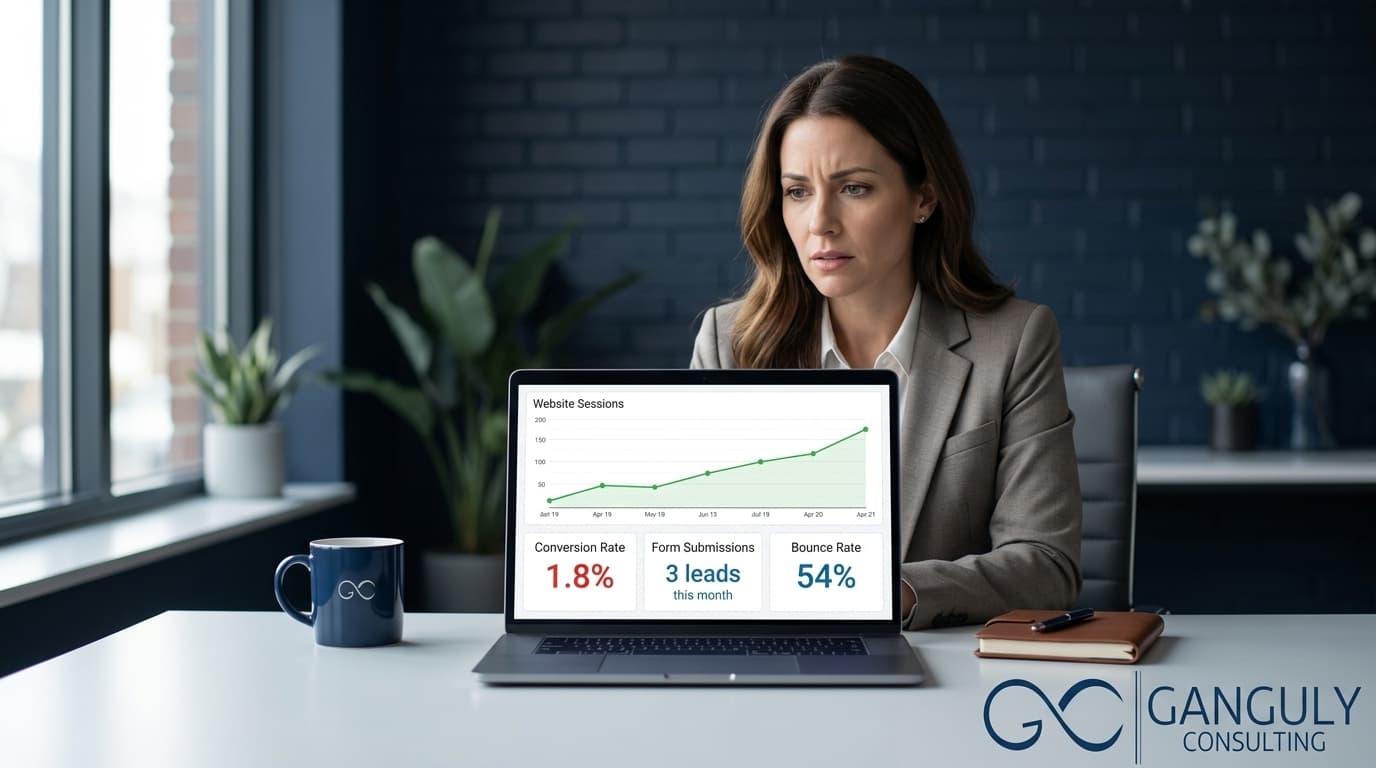
The average service business website converts less than 3% of visitors. The problem is almost never what founders assume — it's not the design, the traffic, or the SEO. Here's what's actually breaking your site's ability to generate leads.
Why Your Website Isn't Generating Leads (And It's Probably Not What You Think)
You've invested in the website. The design looks professional. The copy describes your services clearly. Traffic is coming in — maybe from ads, maybe from search, maybe from referrals who checked you out before getting in touch. And yet the enquiries are not coming. The phone isn't ringing. The contact form sits empty.
Most service business founders, at this point, assume one of three things: the traffic quality is wrong, the design needs a refresh, or they need better SEO. In most cases, they're wrong on all three.
The average website conversion rate across all industries is 2.35%, with top-performing sites reaching 11% or more (Invesp, 2025). For professional services specifically, B2B conversion benchmarks tracked across 25 industries put consulting at just 1.7% — among the lower half (First Page Sage, 2025). That means for every 100 people who visit a typical service business website, fewer than 2 take any meaningful action.
This is not primarily a traffic problem or a design problem. It's a conversion problem — and conversion problems have specific, diagnosable causes. This post covers the real reasons service business websites fail to generate leads, backed by research that most founders haven't seen, with a practical fix for each one.
Read more: The Complete Guide to Building a Digital Growth System for Service Businesses
Key Takeaways
- The average service business website converts less than 2.35% of visitors; top performers reach 11%+ (Invesp, 2025)
- 53% of visitors exit after viewing only one page — meaning most traffic never reaches your contact form (Contentsquare, 2025)
- 61% of B2B buyers now prefer to research and decide without speaking to a salesperson — your website is doing the selling (Gartner, 2025)
- Landing pages with a single CTA convert at 13.5% vs. multi-CTA pages — focus beats variety (Unbounce, 2024)
- Copy written at a 5th–7th grade reading level converts at 11.1% — more than twice the rate of professional/jargon-level writing at 5.3% (Unbounce, 2024)
The Real Job of a Service Business Website in 2026
Before diagnosing what's broken, it's worth resetting what your website is actually supposed to do — because most service businesses are measuring the wrong thing.
A website is not a brochure. It's not a portfolio. It's not a credibility signal you point people to after they've already decided to hire you. In 2026, your website is your primary salesperson — and it's working (or not working) 24 hours a day.
61% of B2B buyers now prefer a rep-free buying experience, making their purchasing decisions without ever speaking to a salesperson (Gartner, 2025). They arrive at your website, form an opinion in under a minute, decide whether you're credible, and either take action or leave. Nobody told them to do this — it's just how buyers behave now.
This means your website has one job: take a qualified visitor and move them to the next step in your pipeline. Not inform them. Not impress them. Convert them.
Most service business websites are not built to do this. They're built to exist — to answer the question "do you have a website?" rather than "does your website generate leads?"
The gap between those two things is enormous. And the reasons for it are almost always the same.
Our observation: When we audit a service business website, we ask one question first: what is the single action this site is designed to get a visitor to take? In most cases, there isn't a clear answer. The site has a contact page, a phone number in the header, a "get in touch" link in the footer, and a "learn more" button that goes to a services page. None of these represent a designed conversion path. The site is trying to be everything to everyone — and converting no one.
Reason 1: You're Losing 53% of Visitors Before They See Anything That Matters
53% of users exit a service business website after viewing only a single page (Contentsquare, 2025). That means more than half of every visitor you've ever paid for — through ads, SEO effort, or word of mouth — leaves before they've seen your pricing, your testimonials, your case studies, or your contact form.
This isn't a bounce rate problem in the traditional sense. It's a first-impression problem.
94% of a website's first impressions are design-related, not content-related (Lindgaard et al., Behaviour & Information Technology, peer-reviewed). Visitors form a visual judgment before they read a single word — and that judgment happens in under 50 milliseconds. If the design signals "not credible" or "not relevant to me," they're gone before your carefully written headline has been read.
46% of consumers judge a website's credibility primarily by its visual design — more than any other single factor (Stanford Web Credibility Project, 2,684 participants). This doesn't mean you need an expensive redesign. It means your visual presentation needs to match the premium positioning you're trying to claim. If you're charging $5,000–$50,000+ for your services and your website looks like it was built in 2016 with a $200 template, the mismatch alone costs you clients before they've read a word.
The fix: Audit your homepage's first screen (above the fold) with one question: does this, in 5 seconds, communicate who you serve, what problem you solve, and why you're different? If someone has to scroll to understand what you do, you're already losing them.
Reason 2: Your Website Loads Too Slowly — and You Don't Know It
Page speed is the most measurable, most-ignored conversion killer in digital marketing. The data is unambiguous.
Research by Portent across 20 B2B and B2C websites found that a 1-second load time produces roughly a 40% conversion rate. At 2 seconds, it drops to 34%. At 3 seconds, 29% (Portent, 2022, 100M+ page views). Google's own research across 11 million mobile landing pages found that as load time increases from 1 to 10 seconds, mobile bounce probability increases by 123% — and 53% of mobile users abandon a site that takes more than 3 seconds to load (Think with Google).
Most service business websites load in 4–7 seconds on mobile. Run your site through Google PageSpeed Insights right now. The number you get is almost certainly below what it should be.
This matters especially because of the mobile reality for professional services. Contentsquare's 2025 benchmark, tracking 90 billion sessions across 6,000+ websites, found that desktop converts at a rate 74% higher than mobile (Contentsquare, 2026). Unbounce's 2024 analysis of 41,000 landing pages found that professional services websites convert 40% better on desktop — but receive four times more mobile traffic (Unbounce, 2024).
The implication: most of your traffic is arriving on a device that converts at a fraction of the rate — and if your site is slow on mobile, you're compounding that gap at every visit.
The fix: Run Google PageSpeed Insights on your homepage and your primary landing page. Target a score of 80+ on mobile. The most common fixes are image compression, removing unused plugins, and switching to faster hosting. None of these require a developer for more than a few hours.
Read more: Why Your Website, Ads, and CRM Need to Work as One System
Reason 3: You Have Too Many CTAs — Which Is the Same as Having None
The most counterintuitive finding in conversion rate optimization research: giving visitors more choices reduces the number who convert.
Unbounce's analysis of 18,639 landing pages found that pages with a single CTA link averaged a 13.5% conversion rate. As the number of CTAs increases, the conversion rate drops (Unbounce, 2024). HubSpot's study of 330,000 CTAs found that personalized, contextually-relevant CTAs convert 202% better than generic ones (HubSpot).
Most service business websites have 6–10 competing actions available on any given page: a "Contact Us" link in the navigation, a "Book a Call" button in the header, a "Learn More" button in the hero, links to three service pages, a newsletter signup in the footer, and a chat widget in the corner. Each of these is competing for the visitor's attention — and research on decision fatigue shows that when people have too many choices, the most common outcome is no choice at all.
A homepage is not a landing page. But it still needs a primary CTA — one action you want most visitors to take. Everything else on the page should support that action, not compete with it.
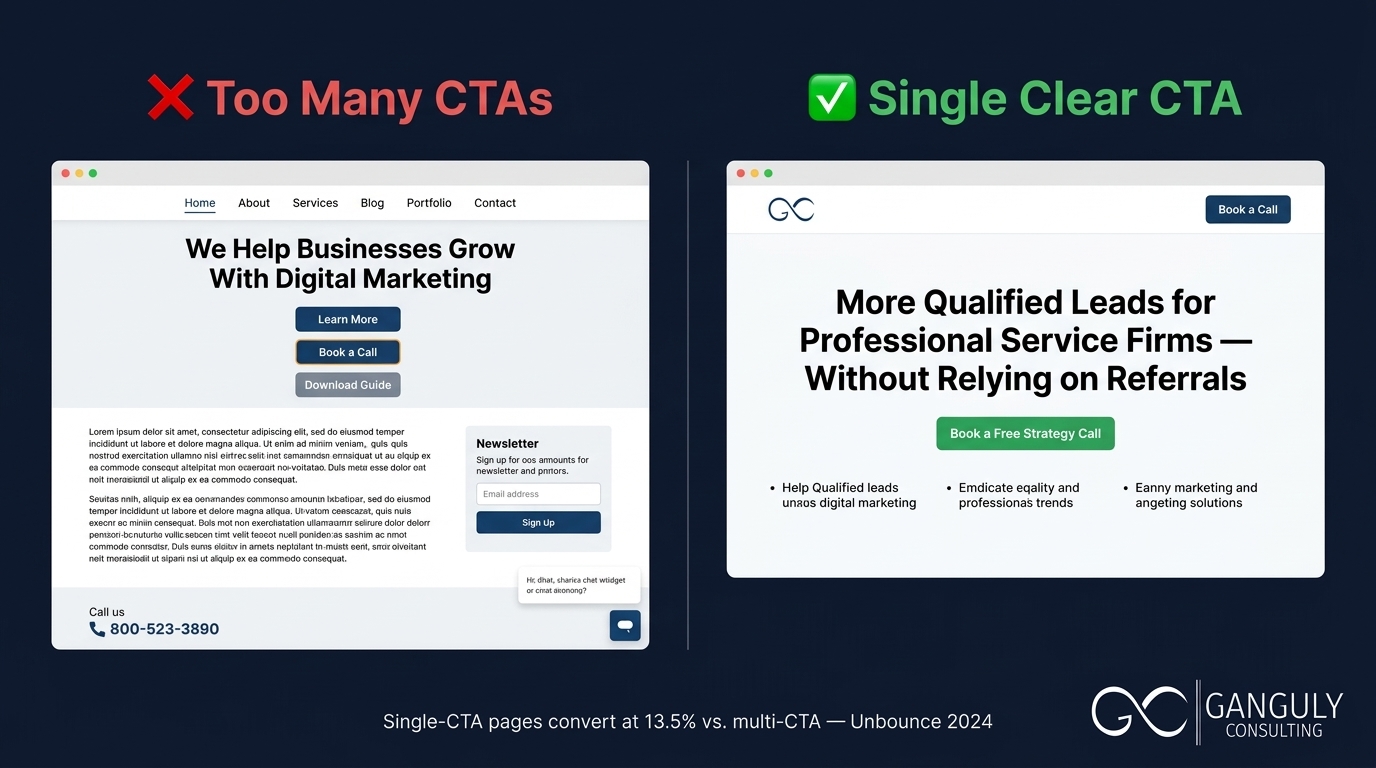
The fix: Identify the one action you want a visitor to take from your homepage. For most service businesses, this is "book a discovery call" or "get a free audit." Every other element on the page should point toward that action or be removed. Secondary CTAs (newsletter, social media follow) belong in the footer — not competing with the primary conversion path.
Reason 4: Your Copy Is Written for You, Not for Your Visitor
This is the hardest one to see from the inside, because the copy feels right to you. You wrote it. You understand what it means. But your visitors aren't you.
Unbounce's 2024 Conversion Benchmark Report, analyzing 57 million conversions across 41,000 pages, found a direct relationship between copy reading level and conversion rate. Pages written at a 5th–7th grade reading level converted at 11.1%. Pages written at an 8th–9th grade level converted at 7.1%. Pages written at a professional or jargon-heavy level converted at just 5.3% (Unbounce, 2024) — and the gap between simple and complex copy widened 62% between 2020 and 2024.
Simpler copy converts at more than twice the rate of jargon-level writing. This is not because your clients are unsophisticated. It's because clarity is a cognitive shortcut. When visitors can understand your value proposition in 5 seconds without effort, they keep reading. When they have to work to understand what you do, they leave.
The most common copy mistakes on service business websites:
- Leading with process, not outcome. "We provide comprehensive digital marketing services" tells a visitor what you do. "We help professional services firms generate consistent leads without depending on referrals" tells them what they get.
- Generic headlines that pass no information. "Welcome to [Firm Name]" or "Growing businesses through digital innovation" could describe any of 10,000 agencies. Say something specific.
- Qualification language aimed at the wrong level. If your clients are founders, not marketing managers, write for founders. They don't want to know your methodology. They want to know the outcome.
The fix: Run your homepage copy through the Hemingway App. Aim for Grade 7 or below. Rewrite your hero headline to answer this question in 10 words or fewer: "What problem do you solve, for whom, and with what result?"
Reason 5: There's No Trust Infrastructure on the Page
18% of online visitors abandon a service without converting specifically because they don't trust the site (Baymard Institute, 2024 — 70,000+ hours of UX research). For service businesses, where the transaction is high-value and often relationship-dependent, trust is not a nice-to-have. It's a conversion prerequisite.
The businesses that convert at the top of the benchmark range — 11%+ — aren't just clearer or faster. They're more credible. They have specific, named social proof. They have a visible, real human being who is accountable for the service. They have evidence that other people like the visitor have trusted them and gotten results.
What trust infrastructure looks like in practice:
- Named client testimonials with company and role, not just a first name and a star rating. "Sarah M., five stars" does nothing. "Sarah Mitchell, COO of Clearfield Partners — increased qualified leads 3x in 90 days" does something.
- A real photo and short bio of the founder or lead consultant. For professional services, people buy from people. The absence of a face is an absence of accountability.
- Specific results, not generic claims. "We deliver results" is noise. "Clients who go through our 90-day lead generation build average 2.4x their qualified call volume" is signal.
- Logos of recognizable clients or publications, where appropriate. Even one or two recognized names create a halo effect for visitors who don't know you.
A single A/B test documented by VWO adding customer testimonials to a checkout page increased conversions by 34% (VWO). The testimonials didn't change the offer, the price, or the design. They changed the trust signal — and that alone moved the conversion rate by a third.
The fix: Add three specific, named testimonials to your homepage or primary landing page. Each one should include the person's full name, their role/company, and a result — not a sentiment. "Ganguly Consulting completely transformed our approach" is a sentiment. "We went from 2 inbound leads per month to 11 in 90 days" is a result.
Read more: The Trust Architecture: 7 Elements That Make Premium Clients Trust You Online
Reason 6: Your Website Isn't Connected to Anything
This is the most expensive reason on the list — and the one that makes all the other problems worse.
Even when a website converts — when someone fills out a form or clicks a booking link — that lead often disappears into an email inbox and is never followed up with consistently. The form submission generates a notification. The notification gets seen two days later. A response goes out. Nothing else happens.
40% of all online visits include detectable user frustration (Contentsquare, 2025). But of the visitors who don't experience frustration, navigate past the first page, find the right CTA, and fill out the form — a meaningful percentage still don't convert into clients, because the follow-up infrastructure doesn't exist.
A website that generates leads but isn't connected to a CRM, an automated confirmation email, and a nurture sequence is a website with a hole in it. Every lead that falls into that hole is a lead you paid to acquire and then failed to convert.
The fix here isn't a website change. It's a systems change — connecting your website's conversion point (the form) to the infrastructure that moves leads through a pipeline.
The fix: Every contact form on your site should connect directly to a CRM. Every form submission should trigger an automated confirmation email within 60 seconds. And a four-email nurture sequence should run automatically for every new lead regardless of whether they book a call immediately.
Read more: Why 65% of Businesses Have No Lead Nurturing Process (And How to Build One)
The Website Audit: 6 Questions to Diagnose Your Conversion Gap
Run through these six questions for your current website. Each "no" represents a diagnosable gap — and a fixable one.
1. Can a first-time visitor understand who you serve and what problem you solve within 5 seconds of landing on your homepage? If your homepage requires scrolling or reading to understand your value proposition, you're failing the first-impression test that determines whether 53% of visitors stay or leave.
2. Is your homepage load time under 3 seconds on mobile? Check with Google PageSpeed Insights. If you're over 3 seconds on mobile, you're losing visitors before they read a word — and Google's research shows bounce probability has already increased meaningfully at that threshold.
3. Does every page have a single, primary CTA — and is it visible above the fold? If you have more than one primary action competing for attention on any given page, you have a decision-fatigue problem. Pick one. Put it where visitors can see it without scrolling.
4. Is your hero headline written at a 7th-grade reading level or below, and does it name a specific outcome rather than a process? Run it through the Hemingway App. If the grade level is above 9, rewrite it. If it describes what you do rather than what the visitor gets, rewrite it.
5. Does your homepage or primary landing page include at least three named, results-based testimonials? "Great to work with" is not a testimonial. A named client with a specific result is a trust signal. If you don't have three of these on your primary page, you're missing the single most effective trust lever available to you.
6. When someone fills out your contact form, does an automated follow-up go out within 60 seconds? If the answer is "no" or "I'm not sure," you have a systems gap that's costing you leads you've already acquired.
Frequently Asked Questions
How do I know if my website's conversion rate is normal or below average?
For service businesses, a realistic conversion benchmark from organic and referral traffic is 2–4%. Paid traffic to a dedicated landing page should convert at 5–12% when the message is well-matched to the ad. If you're below 2% on organic traffic or below 5% on paid traffic to a dedicated page, there's a diagnosable gap worth fixing. Use Google Analytics (GA4) with Goal tracking to measure this. If you don't have goal tracking set up, that's the first fix — you can't improve what you're not measuring.
Should I rebuild my website or optimize what I have?
Rebuild only if the current site has structural problems that can't be patched — if it's running on a platform that can't support fast load times, if it's not mobile-responsive, or if the information architecture is fundamentally wrong. In most cases, the highest-leverage changes are copy rewrites, CTA simplification, trust signal additions, and speed improvements — none of which require a rebuild. 80.8% of companies that start a website redesign cite low conversion rates as the trigger (Digital Silk, 2025) — but most of those conversion problems can be solved without a full rebuild.
Does my website need a blog to generate leads?
Not to start. A blog supports long-term organic search traffic and authority building, but it's not what makes a website convert. A website converts because of its headline clarity, load speed, trust signals, CTA focus, and connection to a follow-up system. Add a blog once the conversion infrastructure is solid — not as a substitute for fixing it. Publishing 10 blog posts on a site that converts at 0.5% produces 10 posts' worth of traffic that goes nowhere.
How many pages does a service business website actually need?
For lead generation, the minimum viable set is: a homepage, a services page, an about page (with a real photo and bio), and a contact or booking page. Optionally, a dedicated landing page for your primary paid traffic campaign — which should live outside the main site navigation. That's five pages. You don't need 20. You need five pages that each do their job clearly and point visitors toward a single conversion action.
What's the fastest single change I can make to improve conversion?
Rewrite your homepage headline. It's the first thing every visitor reads, it takes 30 minutes to test a new version, and the research is clear: specificity and simplicity outperform vague, professional-sounding copy by a factor of 2x. Write a headline that names your target client, their specific problem, and your specific result. Test it for 30 days. The conversion improvement from a better headline alone typically outperforms months of design tweaks.
Your Website Isn't the Problem — Your Expectations of It Are
A website that sits there looking professional is not a lead generation asset. It's a business card with a URL. The difference between a business card and a lead generation asset is not the design, the technology, or the volume of traffic. It's the clarity of the conversion path, the speed of the first impression, the simplicity of the copy, the weight of the trust signals, and the system waiting on the other side of the form.
All five of those things are fixable without a rebuild, without a new agency, and without a significant budget increase. What they require is a diagnostic approach — identifying which specific gap is causing the conversion shortfall — and fixing it one layer at a time.
The businesses that convert at 11%+ aren't doing something fundamentally different. They're doing the fundamentals correctly: one clear CTA, fast load time, simple copy, real social proof, and a follow-up system that catches every lead the website generates. Build those five things into your current website, and the conversion rate will follow.
Read more: The 7 Elements Every Service Business Website Needs to Convert Visitors
Abhisek Ganguly is the founder of Ganguly Consulting, a premium tech and growth consulting firm that helps service businesses build integrated digital growth systems. Ganguly Consulting works at the intersection of technology, marketing, and business strategy.