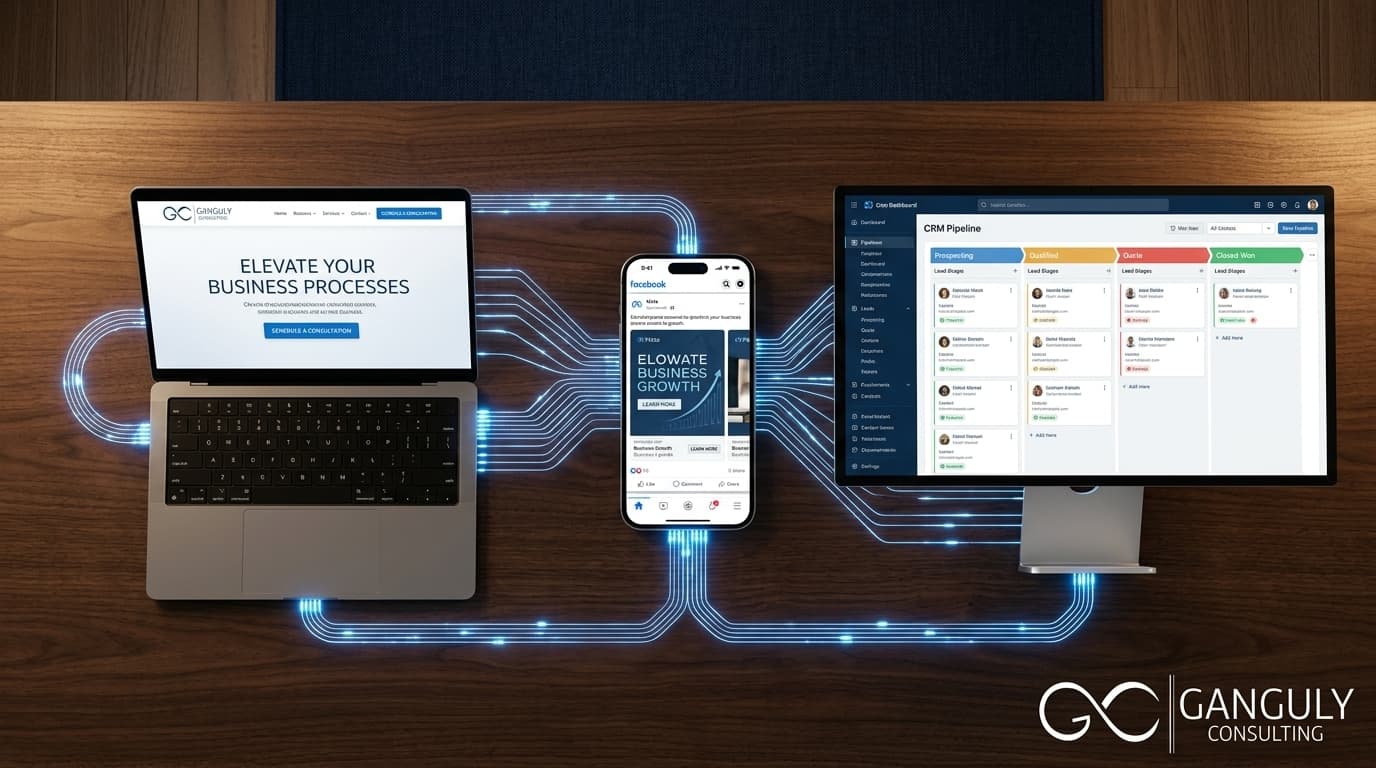
83% of businesses say silos block strategy alignment. Here's why treating your website, ads, and CRM as separate projects is costing you leads and what to do instead.
Why Your Website, Ads, and CRM Need to Work as One System (Not Three Projects)
Most service businesses are running three separate projects at the same time and calling it a marketing strategy. There's the website — built once and rarely touched. There are the ads — handed to an agency or freelancer who optimizes for clicks. And there's the CRM — barely used, mostly a contact list. Each one cost money. None of them talk to each other. And the leads? They fall through the gaps between all three.
This isn't a tools problem. It's a systems problem. And it's far more common than most business owners realize.
Read more: The Complete Guide to Building a Digital Growth System for Service Businesses
Key Takeaways
- 83% of businesses say marketing silos block strategy alignment (Amra and Elma, 2025)
- Multi-channel integrated campaigns achieve 31% lower cost per lead than siloed outreach (Sopro, 2025)
- CRM use alone boosts lead conversions by up to 300% — but only when it's connected to your ad and website data (DemandSage, 2026)
- The fix isn't more tools — it's connecting the ones you already have into one system
What Does "Siloed Marketing" Actually Cost You?
Siloed marketing costs more than most founders expect. According to research compiled by Amra and Elma (2025), 83% of businesses say organizational silos block strategy alignment, 47% of CMOs say silos prevent them from proving ROI, and teams lose an average of 2.4 hours per day to fragmented, disconnected data.
For a service business, this shows up in a specific way. Your Meta ads drive traffic to a landing page that wasn't built to match the ad's promise. Leads fill out a form but never get a follow-up sequence that reflects what they clicked on. Your CRM has contacts with no context — no source, no ad creative, no page visited. You're paying for attention you can't convert.
The problem isn't that any single piece is broken. It's that nothing is connected.
Our observation: When we audit a service business's digital setup, the most common failure point isn't the ad creative or the website design — it's the handoff. The moment a lead moves from ad to landing page to CRM, information gets lost, follow-up gets generic, and conversion drops. The gap between tools is where revenue disappears.
Read more: The Real Cost of Siloed Marketing (And How to Fix It)
Why Your Ads Perform Below Their Potential
Meta ads are the most common entry point for this conversation. A business owner spends $2,000 to $5,000 a month on ads, sees a decent click-through rate, and still can't understand why the phone isn't ringing. The ad isn't the problem.
When someone clicks a Meta ad, they've made a micro-commitment. They responded to a specific message, a specific image, a specific promise. If the landing page they arrive at is your generic homepage — or a page that doesn't echo that same message — that commitment evaporates. According to WordStream's 2025 Facebook Ads Benchmarks, the average conversion rate for Meta lead gen campaigns is 7.72%. But that number assumes some level of message match between ad and landing page. Without it, you're operating well below that baseline.
The fix isn't a better ad. It's building the page to receive the traffic the ad sends — with the same offer, the same language, and a clear next step that feeds into your CRM automatically.
Multi-channel campaigns that connect ads, landing pages, and follow-up achieve 31% lower cost per lead than single-channel or siloed outreach (Sopro, 2025). That 31% isn't magic. It's what happens when a lead doesn't have to re-orient themselves at every step.
Read more: Meta Ads + Landing Page + CRM: The Lead Gen Stack That Actually Works
Why Your CRM Isn't Doing What You Paid For
Here's a stat worth pausing on. CRM use can boost lead conversions by up to 300% (DemandSage, 2026). So why do most service businesses feel like their CRM is a glorified spreadsheet?
Because a CRM disconnected from your ad data and your website is just a contact list. It doesn't know where a lead came from, what ad they saw, which page they visited, or what they're actually interested in. Without that context, follow-up is generic. Generic follow-up doesn't convert.
The 300% conversion lift is real — but it happens when the CRM is connected. When a lead's source, behavior, and interest are captured automatically and used to trigger the right follow-up sequence. Not when someone manually exports a CSV from your ad account and imports it into a separate system every Tuesday.
65% of businesses have no lead nurturing process in place at all (Sopro, 2025). That's not a CRM product problem. That's a systems design problem.
Our observation: The businesses that get the most from their CRM aren't the ones with the most expensive plan. They're the ones who spent two hours connecting their ad account, their form, and their email sequence so the system runs without manual input. The tool doesn't matter much. The connections do.
Read more: How to Build a Lead Generation System That Doesn't Depend on Referrals
What a Connected System Actually Looks Like
A connected system isn't complicated. It doesn't require enterprise software or a technical team. Here's what it looks like in practice for a service business:
1. Your ad targets a specific audience with a specific message. Not "we help businesses grow." Something more specific: "Struggling to convert website traffic into discovery calls? Here's the system that fixes it." The specificity of the message determines the quality of who clicks.
2. The landing page extends that exact message. Same headline concept. Same promise. One action — fill in a form, book a call, download a guide. No navigation. No distractions. The page exists for one job.
3. The form submission triggers an automatic CRM entry. The lead's source, the ad they saw, and the page they converted on are captured. A follow-up sequence starts immediately — within minutes, not days. The first message acknowledges exactly what they were interested in.
4. Your reporting connects the dots. You know which ad generated which lead, what that lead did after the call, and whether the campaign was worth what you paid. Not gut feel. Actual numbers.
That's it. Four steps. Most service businesses are missing steps two and three entirely.
In practice: When we work with a new client, we typically find that ads and CRM exist but the middle two steps are absent. There's no dedicated landing page — traffic goes to the homepage. And form submissions land in an email inbox, not a CRM sequence. Fixing those two gaps, before touching ad spend, is usually the highest-leverage move available.
Read more: The 5 Layers of a Digital Growth System Every Service Business Needs
Why Most Businesses Treat These as Separate Projects
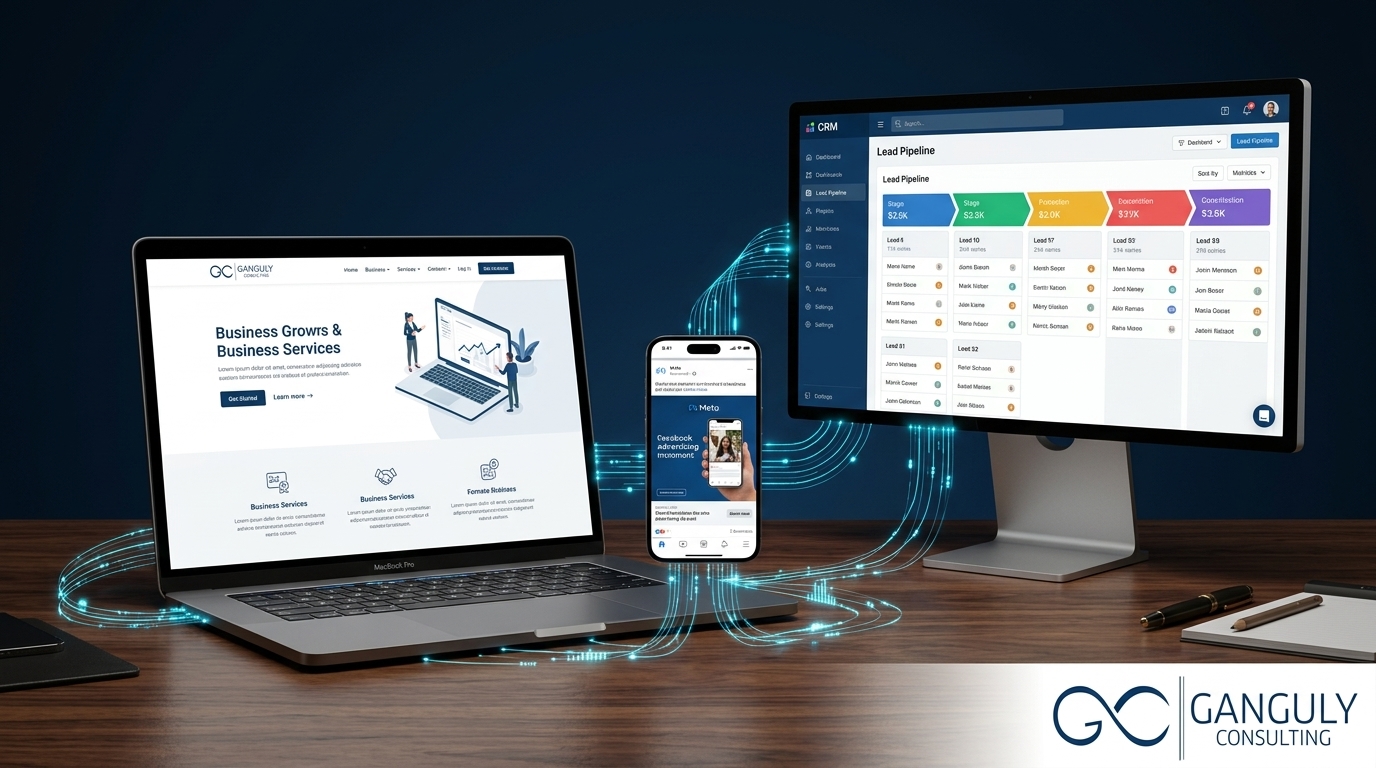
The reason most businesses end up with three disconnected tools is almost always structural. The website was built by a web designer. The ads are managed by a media buyer or agency. The CRM was set up by whoever handles the sales side. Each person optimized their piece without thinking about the handoffs.
That's a vendor problem disguised as a technology problem. And it's exactly why businesses can spend $60,000 a year on marketing and still not know what's working.
Marketing automation — which connects these pieces — delivers a 544% return on investment over three years, and companies using it generate 80% more leads while seeing 77% higher conversion rates (Thunderbit, 2026). Those aren't numbers from enterprise companies with large teams. They reflect what happens when even basic automation connects your existing tools.
The bar isn't high. But it does require thinking about your digital setup as a system — not three separate vendor relationships.
Read more: How to Build a Lead Generation System That Doesn't Depend on Referrals
How to Start Connecting Your System This Week
You don't need to rebuild everything. Start with the highest-impact gap.
Step 1: Audit your current handoffs. Where does a lead go after clicking your ad? Does the page they land on match the ad's message exactly? When they fill out a form, where does that lead go — and how fast do they hear from you?
Step 2: Fix the landing page first. If your ads are sending traffic to your homepage, that's the single most impactful change you can make. Build one focused page for your primary ad campaign. Match the headline to the ad copy. One offer, one form.
Step 3: Connect your form to your CRM automatically. Tools like Zapier, Make (formerly Integromat), or native integrations make this straightforward. Every form submission should create a CRM contact with source data attached.
Step 4: Write three follow-up emails. You don't need a 12-step nurture sequence to start. Write one email for the first hour, one for day two, one for day five. Each one adds value and moves the conversation forward. Schedule them to fire automatically from your CRM.
Step 5: Set up one dashboard. Track three numbers weekly: leads from ads, conversion rate from landing page, and follow-up response rate. That's enough to start making informed decisions.
Only 21% of marketing leaders can accurately measure the return on their marketing investment (ResearchAndMetric, 2025). If you do these five steps, you'll be ahead of the other 79%.
Is This Worth Building Before You Scale Ad Spend?
Yes. Every time.
The instinct when leads are thin is to spend more on ads. But if your landing page isn't converting, more traffic just means more wasted spend. If your CRM isn't capturing source data, scaling just makes attribution harder. If there's no follow-up sequence, leads go cold no matter how well the ad performed.
Build the system first. Then scale the spend into it.
A connected digital growth system isn't a long-term project. For most service businesses, the foundation — a dedicated landing page, a connected form, and a basic follow-up sequence — can be set up in a week or two. What it gives you in return is clarity, consistency, and a meaningful improvement in what your ad spend actually produces.
Read more: How to Build a Lead Generation System That Doesn't Depend on Referrals
Frequently Asked Questions
Does my website need to be rebuilt to connect it to my ads and CRM?
No. In most cases, you need one well-built landing page — not a full website rebuild. The landing page sits outside your main site navigation and is built specifically to receive ad traffic. Your main website stays as-is. Most CMS platforms (WordPress, Webflow, Squarespace) let you build a standalone page without touching the rest of the site.
How long does it take to connect Meta ads, a landing page, and a CRM?
For a service business starting from scratch, a basic connected system — one landing page, one CRM integration, and a three-email follow-up sequence — typically takes one to two weeks to set up properly. The biggest time investment is writing the landing page copy and the follow-up emails. The technical connections (form to CRM, CRM to email sequence) are usually an afternoon's work with tools like Zapier or native integrations.
What CRM should a service business use to connect with Meta ads?
The right CRM depends on your workflow, but HubSpot (free tier), GoHighLevel, and ActiveCampaign are the most commonly used by service businesses running Meta ads. All three have native or Zapier-based integrations with Meta Lead Ads. What matters more than the tool is that source data — which ad, which campaign, which audience — is captured on every lead record automatically.
What's the difference between a landing page and a website homepage?
A homepage serves multiple audiences and multiple purposes — it's built for discovery. A landing page serves one audience with one goal: conversion. It has no navigation menu, no links to other pages, and one clear call to action. When you run paid ads, sending traffic to a homepage loses the message match that made someone click. A dedicated landing page keeps that context intact and dramatically improves conversion rates. Average landing page conversion rates for service businesses using Meta ads run between 5% and 12% when message match is strong (WordStream, 2025).
How do I know if my current system is siloed?
Ask yourself three questions. First: when someone clicks your ad and fills out your form, does that contact automatically appear in your CRM with the source tagged? Second: does a follow-up email go out within the first hour, automatically, without anyone touching it? Third: can you see, in one place, how many leads came from your ads this month and what happened to each of them? If the answer to any of these is no, your system has gaps worth fixing. That's where leads are being lost.
The System Is the Strategy
There's a version of this problem that gets expensive fast. Business owners hire three vendors — a web designer, a media buyer, and a CRM consultant — and wonder why growth stays flat. Each vendor delivers their piece. None of them own the handoffs. And the business keeps paying for three separate projects that never become one system.
The businesses that grow consistently aren't the ones with the best ads or the most expensive website. They're the ones where every click leads somewhere deliberate, every lead gets followed up with context, and every campaign produces data that improves the next one.
That's what a connected system gives you. And it starts with deciding that your website, your ads, and your CRM are not three projects. They're one machine — and it's time to build it that way.
Read more: The Complete Guide to Building a Digital Growth System for Service Businesses
Abhisek Ganguly is the founder of Ganguly Consulting, a premium tech and growth consulting firm that helps service businesses build integrated digital growth systems. Ganguly Consulting works at the intersection of technology, marketing, and business strategy.