65% of businesses have no lead nurturing process. Here are the 5 layers every service business needs to build a digital growth system that generates consistent, qualified leads.
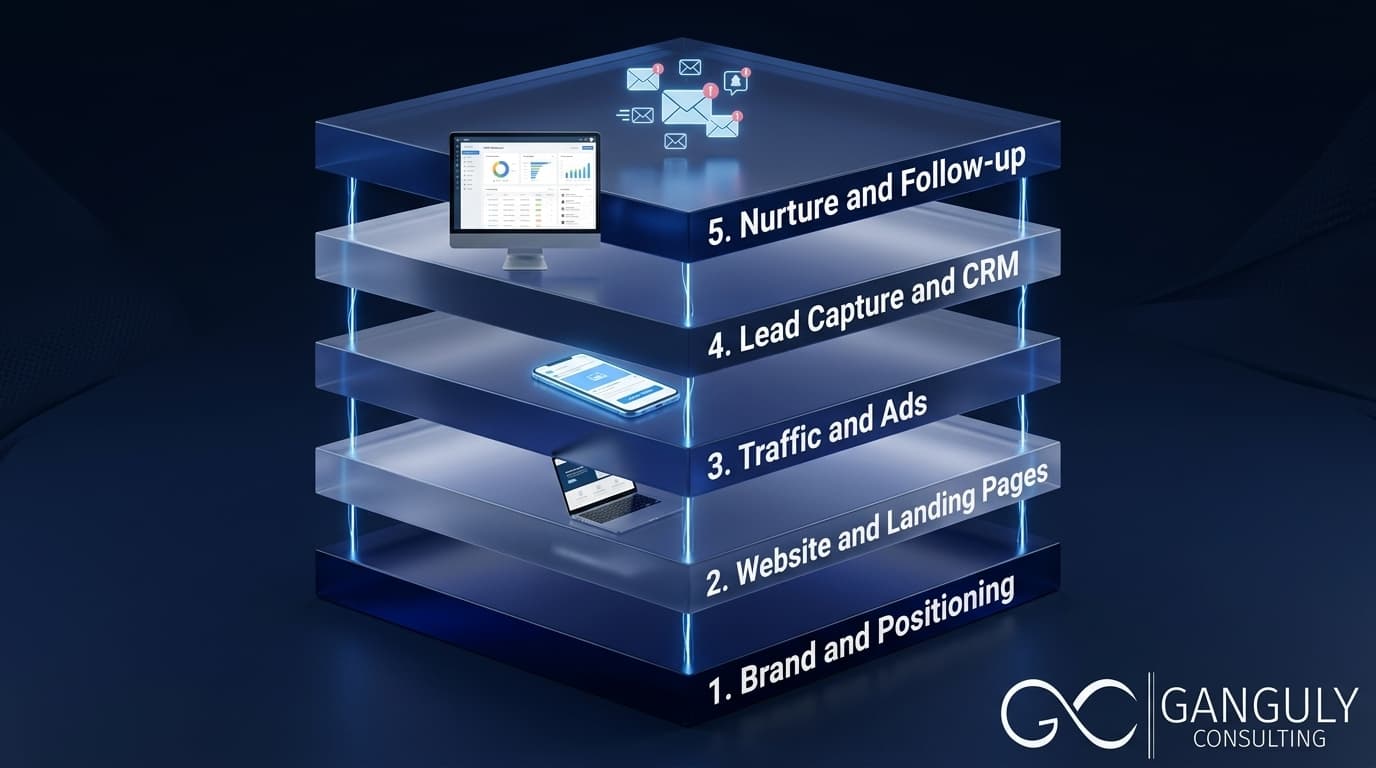
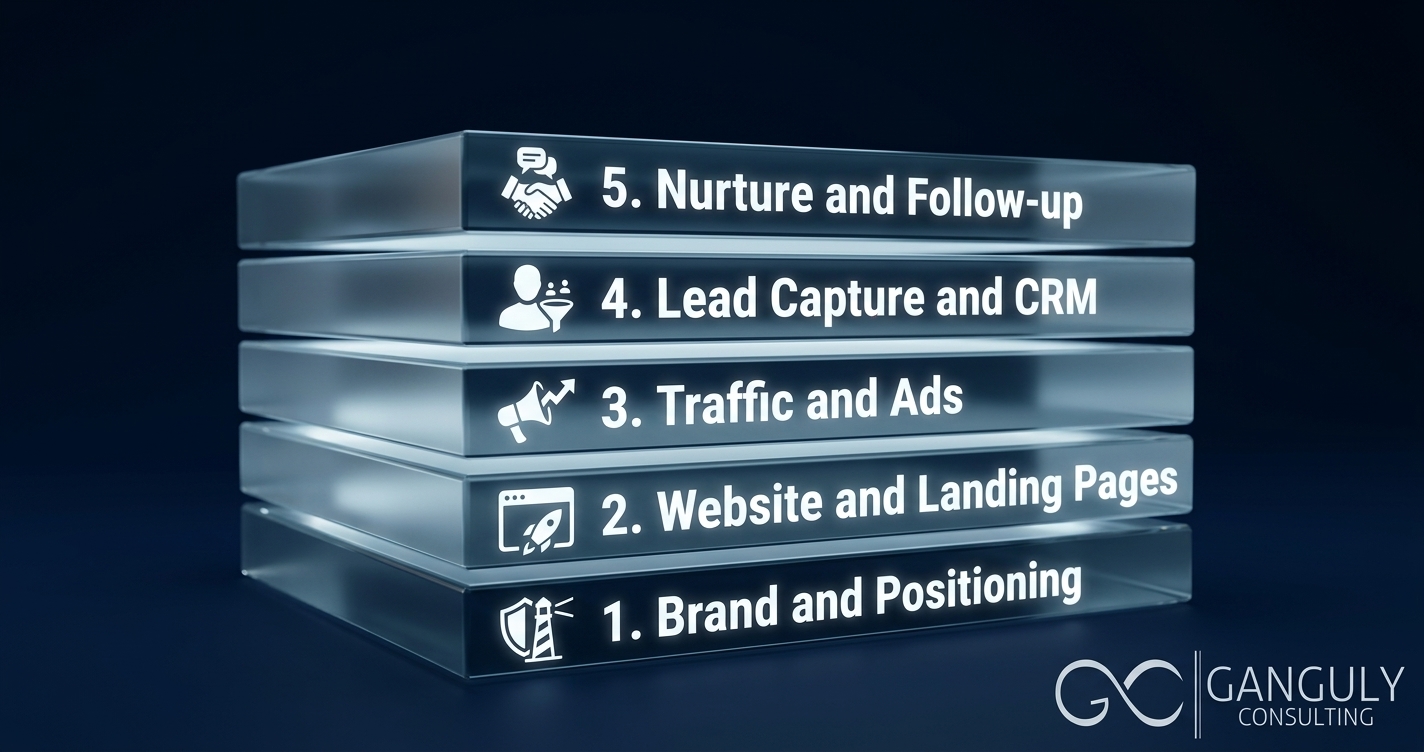
The 5 Layers of a Digital Growth System Every Service Business Needs
Most service businesses don't have a growth problem. They have a systems problem. They're running ads without a conversion infrastructure to receive the traffic. They have a website that looks professional but does nothing to qualify or capture leads. They have a CRM with contacts sitting in it that never get followed up with.
Each of these is a layer missing from a complete system. And when any layer is missing, the whole thing leaks.
A digital growth system is what makes your marketing work together instead of working in parallel. It's not a single tool, a single campaign, or a single hire. It's a connected infrastructure — five distinct layers that, when built and integrated, generate qualified leads consistently without depending on referrals, word of mouth, or whatever platform is performing well this quarter.
Read more: Why Your Website, Ads, and CRM Need to Work as One System
Key Takeaways
- Only 21% of marketing leaders can accurately measure ROI — because most businesses skip the foundational layers (ResearchAndMetric, 2025)
- 65% of businesses have no lead nurturing process — meaning most leads are lost after first contact (Sopro, 2025)
- Marketing automation delivers 544% ROI over three years when all five layers are connected (Thunderbit, 2026)
- A digital growth system isn't built layer by layer in sequence — but if any layer is missing, the others can't compensate
Why Most Service Businesses Stay Stuck Despite Spending on Marketing
Only 21% of marketing leaders can accurately measure the return on their marketing investment (ResearchAndMetric, 2025). That's not because they're spending too little — it's because they're spending without a foundation. The reason marketing spend doesn't compound is almost always structural: the layers of a functioning growth system are either missing or disconnected.
A service business owner running Meta ads is buying attention. But attention without conversion infrastructure is just traffic. Traffic without lead capture is just visits. Lead capture without follow-up is just a list. The problem isn't the ad. It's that the ad is the only layer in place.
Our observation: When we audit a service business that says "marketing isn't working," we almost never find that the individual tactics are wrong. We find that the layers aren't connected. The ads exist. The website exists. The CRM exists. But they operate as three separate projects rather than one system. That gap — not the tactics themselves — is what's costing the business.
Understanding the five layers doesn't require a large team or a large budget. It requires clarity on what each layer does, what it depends on, and what breaks when it's absent.
Read more: The Real Cost of Siloed Marketing (And How to Fix It)
Layer 1: Audience and Positioning
The foundation of every digital growth system is knowing precisely who you serve and what you offer that no one else does. This sounds obvious. It almost never is in practice.
62% of customers will ignore a business that doesn't have a clear web presence (Levitate AI, 2025). But the deeper issue isn't the absence of a web presence — it's the absence of a clear message on that presence. Most service business websites try to speak to everyone. That's the same as speaking to no one.
Positioning means being specific: specific about the client type, the problem you solve, the result you deliver, and why your approach is different. Without that clarity, every layer above it is built on an unstable base. Your ads will attract the wrong audience. Your website won't convert the right people. Your follow-up will feel generic.
The questions every service business needs to answer at this layer:
- Who is the exact client you want? (Industry, size, situation, trigger event)
- What outcome do they want that they're willing to pay a premium for?
- Why would they choose you over the obvious alternatives?
When those three questions are answered clearly, every other layer of the system becomes significantly easier to build. Traffic becomes more targeted. Conversion rates go up. Follow-up sequences get more specific. The positioning layer isn't a branding exercise — it's the infrastructure on which everything else runs.
Read more: The Trust Architecture: 7 Elements That Make Premium Clients Trust You Online
Layer 2: Traffic and Visibility
Positioning tells you who you're targeting. Traffic and visibility is how you get in front of them. This layer has three components: paid advertising, organic search (SEO and content), and direct outreach. Most service businesses rely on one. A functioning growth system uses a mix — not necessarily all three at once, but with a plan for how each feeds the system.
Multi-channel campaigns achieve 31% lower cost per lead than single-channel outreach (Sopro, 2025). That number reflects what happens when you're not dependent on a single platform or traffic source. If your referrals dry up, your SEO rankings shift, or a Meta algorithm change cuts your reach, a diversified traffic layer means the system doesn't collapse.
For most service businesses at growth stage, the most efficient starting point is paid social — Meta ads, in particular. Not because it's the best long-term channel, but because it's the fastest to test, iterate, and generate data on your positioning. If the ad doesn't get clicks, the positioning is unclear. If clicks don't convert, the landing page is the problem. Each layer surfaces issues in the layers below it.
Our observation: The businesses that scale paid ads profitably are almost never the ones with the best ad creatives. They're the ones who treat the ad as a diagnostic tool first. The ad tells you whether your message is landing. The landing page tells you whether your offer is compelling. The CRM tells you whether your follow-up is converting. Each layer gives you data about the one before it — if you're reading the signals.
SEO and content serve a different function: they build compounding visibility over 12–18 months and attract buyers who are actively searching for what you offer. They're slower to start but increasingly efficient over time. Direct outreach fills the gap in the early stages when ads and SEO haven't yet built volume.
Read more: Meta Ads + Landing Page + CRM: The Lead Gen Stack That Actually Works
Layer 3: Website and Conversion Infrastructure
Most service business websites are built for one purpose: to look credible when someone Googles the business name. That's a different job than converting a stranger who arrived from a paid ad.
A conversion infrastructure means your site — and specifically your landing pages — are built to do a job: take someone who has shown interest and give them a clear, compelling reason to take one action. Not five. One. Book a call. Fill out a form. Download a guide.
The gap here is almost always the same: traffic arrives from an ad or a search result, hits a generic homepage or a page with too many options, and leaves without converting. No navigation menu. No distractions. No competing calls to action — these aren't design principles, they're conversion mechanics. A focused landing page consistently outperforms a homepage for paid traffic because it maintains the message match between what the ad promised and what the page delivers.
According to WordStream's 2025 Facebook Ads Benchmarks, average Meta lead gen conversion rates sit around 7.72%. That baseline assumes some level of message match. Without a dedicated landing page, most businesses operate well below it.
83% of businesses say silos block strategy alignment (Amra and Elma, 2025). In most cases, the web layer and the traffic layer were built by different people — a web designer and a media buyer — who never coordinated on what the page needed to do for the ad to work. That structural gap shows up as poor conversion rates and wasted ad spend.
Your conversion infrastructure doesn't need to be complex. It needs to be purposeful. One landing page per primary offer, built to receive the specific audience and message your ads are sending. That's the standard.
Read more: The 7 Elements Every Service Business Website Needs to Convert Visitors
Layer 4: Lead Capture and CRM
Capturing a lead isn't enough. What matters is capturing the lead with context — and routing it into a system that can act on that context automatically.
CRM use can boost lead conversions by up to 300% (DemandSage, 2026). But that figure depends entirely on how the CRM is connected. A CRM that receives a manual CSV export once a week and stores names with no source data isn't delivering that return. A CRM that receives leads automatically, with the campaign source, ad creative, and page visited attached to each record, is a different tool entirely.
This layer has two jobs. First: capture every lead that converts on your landing page and get them into your CRM without manual intervention. Second: tag that lead with enough context to make follow-up specific. Which ad campaign brought them in? Which offer did they respond to? Which page did they convert on? That data is what turns a generic "thanks for your enquiry" email into a follow-up that references exactly what they were interested in.
In practice: When we set up this layer for a new client, the first thing we do is connect the landing page form directly to the CRM via a native integration or Zapier. Then we add a hidden field that captures the UTM source from the ad. Within 48 hours, the client has a CRM where every new contact shows exactly which campaign, ad set, and ad creative they came from. It takes an afternoon to build. The data it produces changes how every future decision gets made.
The tools here — HubSpot, GoHighLevel, ActiveCampaign, Pipedrive — matter less than the configuration. A well-configured basic CRM outperforms an expensive CRM that's not connected to your traffic and conversion layers.
Read more: How to Build a Lead Generation System That Doesn't Depend on Referrals
Layer 5: Nurture and Follow-up
65% of businesses have no lead nurturing process in place (Sopro, 2025). That's the single most common and most expensive gap in a service business's digital setup. A lead that fills out your form and doesn't hear from you within an hour has a dramatically lower chance of converting than one who receives a relevant, personal-feeling message within minutes.
Nurture and follow-up is the layer that converts leads into clients. It's the automated sequence that triggers from a CRM entry and walks a prospect from initial interest to booked call. Without it, leads go cold. With it, the system runs without requiring someone to manually check a form submission inbox every morning.
Marketing automation — the technology that powers this layer — delivers 544% ROI over three years, and businesses using it generate 80% more leads while converting at 77% higher rates (Thunderbit, 2026). Those results aren't from complex sequences or sophisticated AI-driven personalization. They come from basic automation: a form submission triggers an immediate confirmation email, then a follow-up 24 hours later, then a value-add three days after that. The sequence is predictable. The conversion is not left to chance.
The minimum viable nurture sequence for a service business has three components:
First contact (within 5 minutes of form submission): Acknowledge what they expressed interest in, set expectations for next steps, and add something useful — a relevant piece of content, a short video, a single insight. Not a sales pitch. Context.
Day two follow-up: One specific question or one specific resource. Keep it short. Keep it relevant to what they originally responded to.
Day five close loop: A direct, low-pressure ask. "Are you still looking for help with X? Happy to set up a quick call this week." Simple. Specific. Easy to respond to.
Three emails. Automated. That's the difference between a lead list and a lead pipeline.
Read more: Why 65% of Businesses Have No Lead Nurturing Process (And How to Build One)
What Happens When All Five Layers Work Together?
When the five layers are connected, the economics of your marketing change. Your ad spend becomes more efficient because qualified traffic lands on a page built to convert it. Every conversion enters a CRM with source data attached. Every CRM entry triggers a follow-up sequence that runs without manual input. Your reporting connects the ad to the lead to the outcome, so you know what's working and what isn't.
That's not a theoretical outcome. It's what happens when you stop treating your website, your ads, and your CRM as three separate tools and start treating them as one system.
The 31% lower cost per lead from multi-channel integrated campaigns (Sopro, 2025) isn't a product of better creative or smarter targeting. It's a product of the layers reinforcing each other. A strong positioning layer makes the traffic layer more targeted. A conversion-optimized landing page makes the traffic spend more efficient. A connected CRM makes the follow-up layer more relevant. The whole system compounds.
Our observation: The businesses that get the best return from their marketing aren't necessarily the ones spending the most. They're the ones where all five layers exist and are connected. Even a basic, no-frills version of each layer — clear positioning, one paid channel, one landing page, one CRM, one three-email sequence — outperforms a more expensive, more sophisticated setup where the layers aren't integrated.
Read more: Why Your Website, Ads, and CRM Need to Work as One System
How to Assess Which Layer You're Missing
Most service businesses aren't missing all five layers. They're missing one or two — and the missing layers are usually in the middle. Here's a quick diagnostic:
If leads are coming in but not converting into clients: The problem is almost always Layer 4 or Layer 5. Either the CRM isn't capturing enough context to make follow-up relevant, or the follow-up sequence doesn't exist.
If traffic is arriving but leads aren't being captured: The problem is Layer 3. The conversion infrastructure isn't doing its job — the landing page, the offer, the form, the call to action need attention.
If you're spending on ads but attracting the wrong people: The problem is Layer 1. The positioning isn't specific enough, and it's showing in who responds to the ads.
If you can't tell what's working: The problem spans Layers 4 and 5, and potentially Layer 2. You don't have the source data in your CRM to trace outcomes back to campaigns.
The diagnostic is straightforward. The work is specific. You don't need to rebuild everything — you need to identify which layer is missing or broken and fix that layer first.
Read more: How to Build a Lead Generation System That Doesn't Depend on Referrals
Frequently Asked Questions
Do I need all five layers before I can start generating leads?
No. You can generate leads with two or three layers in place — but you'll lose most of them without the others. The minimum viable starting point for most service businesses is a basic positioning statement (Layer 1), one paid traffic channel (Layer 2), one dedicated landing page (Layer 3), and a CRM that captures form submissions (Layer 4). Layer 5 — nurture — should be added within the first 30 days. Most leads are lost after first contact, and 65% of businesses have no follow-up process in place (Sopro, 2025).
How long does it take to build all five layers?
For a service business starting from scratch, a basic version of all five layers can be operational in two to four weeks. The longest part is usually Layer 1 — getting positioning clear enough to inform the rest. Layers 3, 4, and 5 — the landing page, CRM connection, and follow-up sequence — are typically one to two weeks of focused work. Layer 2 (paid traffic) can be launched in parallel once the conversion infrastructure is in place.
Which layer has the highest immediate impact?
Layer 5 — nurture and follow-up — delivers the fastest impact for most businesses, because most businesses already have leads coming in that they're not following up with effectively. Marketing automation delivers a 544% ROI over three years (Thunderbit, 2026), and the foundation of that is a basic automated follow-up sequence that fires within minutes of a lead capturing.
What tools do I need to build these five layers?
You don't need an expensive tech stack. For most service businesses, the five layers can be built with: a clear positioning document (no tool required), one paid ad platform (Meta Ads for most), a landing page builder (Webflow, WordPress, or ClickFunnels), a CRM (HubSpot free tier, GoHighLevel, or ActiveCampaign), and an email automation tool (most CRMs include this). A simple integration layer — Zapier or native integrations — connects them. The tools matter less than how they're connected.
How do I know when my digital growth system is working?
Track three numbers weekly: leads generated (from paid traffic), landing page conversion rate, and follow-up response rate (what percentage of leads respond to the automated sequence). When those three numbers are visible and moving in a consistent direction, your system is functioning. Only 21% of marketing leaders can currently measure their ROI (ResearchAndMetric, 2025) — having these three metrics in a simple dashboard puts you ahead of the overwhelming majority.
A System Built to Compound
There's a version of running a service business where growth is always dependent on the next referral, the next good month, the next event. It's exhausting and it's fragile. Each new client has to be found from scratch. When one lead source dries up, revenue stalls.
A digital growth system changes that equation. When your positioning is clear, your traffic is targeted, your landing pages are converting, your CRM is capturing context, and your follow-up is automated, the system generates qualified leads consistently — not because of effort, but because of infrastructure.
The five layers aren't complicated. They're not expensive. They're not exclusive to large businesses with full marketing teams. The service businesses that grow predictably have them. The ones that don't are still dependent on whatever happened to work last month.
Build the system. The results follow the infrastructure.
Read more: How to Build a Lead Generation System That Doesn't Depend on Referrals
Abhisek Ganguly is the founder of Ganguly Consulting, a premium tech and growth consulting firm that helps service businesses build integrated digital growth systems. Ganguly Consulting works at the intersection of technology, marketing, and business strategy.