

Siloed marketing doesn't just waste budget — it makes every marketing dollar you spend less effective than it should be. Here's what disconnected tools, teams, and data actually cost a service business, and the system that fixes it.
The Real Cost of Siloed Marketing (And How to Fix It)
Most service businesses don't know they're running siloed marketing. They think they have a traffic problem, a conversion problem, or a bad-leads problem. In almost every case, the underlying cause is the same: marketing components that were built separately, optimized separately, and measured separately — and therefore can't work together.
A marketing silo is any situation where the people, tools, data, or processes involved in your marketing don't communicate with each other. It shows up in predictable ways: the agency running your ads doesn't know what happens to the leads after they fill out the form. Your website was built by a designer who had no input from whoever manages your CRM. Your email list is in one tool, your ad audiences are in another, and neither is informed by what the other knows.
The cost of this isn't just inefficiency. It's a compounding drag on every marketing dollar you spend. This post quantifies what siloed marketing actually costs a service business — in wasted spend, lost leads, and missed revenue — and lays out the system that fixes it.
Read more: Why Your Website, Ads, and CRM Need to Work as One System
Key Takeaways
- Companies waste an average of 26% of their marketing budget on ineffective channels they can't measure — largely due to siloed data (Nielsen, 2024)
- Businesses using 3+ disconnected marketing tools report 30% more time spent on manual data reconciliation than those with integrated stacks (Zapier, 2024)
- Integrated marketing campaigns produce 3x higher purchase rates than non-integrated campaigns (Omnisend, 2023)
- Only 28% of companies describe their marketing and sales data as "fully integrated" (LinkedIn B2B Institute, 2024)
- The average business uses 91 marketing technology tools — most of which don't talk to each other (Chiefmartec, 2024)
What "Siloed Marketing" Actually Means for a Service Business
In a large enterprise, marketing silos typically mean disconnected departments — a demand gen team that doesn't talk to the content team, a sales ops function that manages the CRM independently from marketing automation. The silo is organizational.
For a service business with 5–50 people, the silo is structural. You probably don't have separate departments. But you likely have separate vendors, separate tools, and a setup where each piece of your marketing was built independently of the others.
Here's what that looks like in practice:
- Your ads are managed by a media buyer or agency whose KPI is cost per click or cost per lead. They hand leads off to you and their job ends there.
- Your website was designed by someone whose brief was "make it look professional." They didn't build it with conversion architecture or CRM integration in mind.
- Your CRM was set up during an optimistic afternoon, has 300 contacts in it, and hasn't had a nurture sequence added since it was created.
- Your email list is in Mailchimp or a similar tool and gets a newsletter when someone remembers to write one — with no connection to what people clicked on in your ads or visited on your site.
- Your analytics show you traffic and bounce rate but tell you nothing about which campaign generated which client.
None of these is a bad vendor or a bad tool. Each one was built for its purpose. The problem is the handoffs — or more precisely, the absence of them.
Our observation: When we audit a service business's marketing setup, we map every handoff point: what information passes from ads to landing page, from form submission to CRM, from CRM to follow-up sequence, from sequence to booking. In almost every audit, at least two of these handoffs are broken — either the data doesn't transfer, or nothing happens at all. The leads aren't lost because the marketing is bad. They're lost in the gaps between pieces that were never designed to connect.
The Measurable Cost of Silos: What the Data Shows
The numbers on siloed marketing are more specific than most business owners expect.
26% of marketing budget is wasted on channels that can't be measured — primarily because the data isn't connected between systems. Nielsen's 2024 Annual Marketing Report found this figure consistent across business sizes, and attributed most of it to broken attribution rather than ineffective channels per se. The channel may be working. Without connected data, you can't tell — so you either keep spending on something that isn't performing, or cut something that is.
The average business uses 91 marketing technology tools (Chiefmartec, 2024). Most of these tools were purchased to solve a specific problem and don't communicate with each other by default. Every additional tool in a disconnected stack adds another handoff point where data can be lost, leads can fall through, and time gets consumed reconciling what each platform shows.
Only 28% of companies describe their marketing and sales data as fully integrated (LinkedIn B2B Institute, 2024). For the other 72%, decisions are made on partial information — which campaigns to run, which audiences to target, which offers to test — without the full picture of what's actually converting.
Integrated multichannel campaigns produce 3× higher purchase rates than non-integrated single-channel or loosely connected campaigns (Omnisend, 2023). That 3× is not from increasing ad spend. It's from connecting the pieces so that each channel reinforces the others.
For a service business spending $3,000–$5,000 a month on marketing — ads, tools, website maintenance — a 26% waste rate means $780–$1,300 a month going to channels you can't measure or improve. Over a year, that's $9,000–$16,000 in budget that produces no usable data and no compound improvement.
Where Silos Actually Form in a Service Business
Silos don't start as intentional decisions. They start as convenience. You hire a freelancer to run ads. You use the form builder that came with your website. You set up a CRM when someone told you that you should. None of these decisions were wrong at the time. The silo forms when each of these pieces is never connected to the others.
The five most common silo points in a service business:
1. The ad-to-landing-page gap. Your ads are driving traffic to a page that wasn't built to receive that specific audience. The ad promises one thing; the page says something different. The media buyer has no input into the landing page, and the web designer didn't know what the ad was saying. Both are doing their job. Neither is responsible for the handoff.
2. The form-to-CRM gap. Form submissions arrive as email notifications. Someone copies the contact manually into a CRM — or doesn't. There's no automation, no source tagging, no pipeline stage assignment. The lead exists in email but not in any system that can manage it.
3. The CRM-to-follow-up gap. Leads sit in the CRM with no sequence running. The sales process depends on whoever checks the CRM that day remembering to follow up. High-intent leads go cold because nobody triggered a sequence within the first hour.
4. The data-to-decisions gap. Your ads platform shows you impressions, clicks, and leads. Your CRM shows you contacts. Your website shows you sessions. None of these numbers connect, so you can't answer the most important question: which campaign generated which client?
5. The agency-to-owner gap. Your marketing agency or freelancer sends you a monthly report showing their metrics — CPL, CTR, impressions. You have no way to verify whether those leads became clients. They're optimizing for their KPIs, not for your revenue.
Read more: The Complete Guide to Building a Digital Growth System for Service Businesses
The Hidden Compounding Cost: Why Silos Get More Expensive Over Time
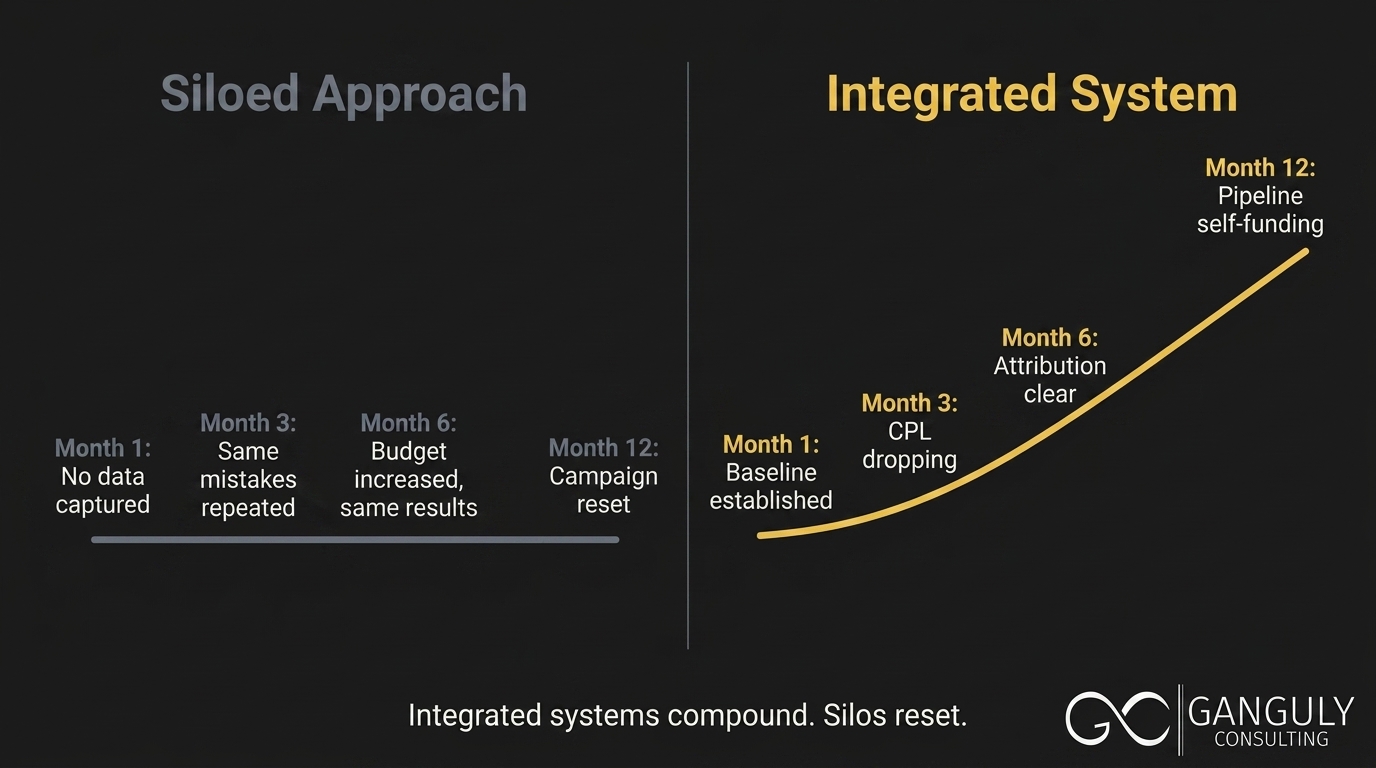
The waste from siloed marketing isn't a fixed cost — it compounds. Here's why.
When your systems don't talk to each other, you can't learn from your campaigns. You run ads for three months, see that you got some leads, can't tell which leads came from which creative, can't tell which leads converted into clients, and have no data to improve the next campaign. So you reset. You try different ad copy based on intuition. You run another three months. Same result.
An integrated system does the opposite. Month one gives you baseline data: cost per lead by campaign, lead-to-call conversion rate by audience, close rate by lead source. Month three lets you compare. You double the budget on the audience with the best lead-to-close rate and cut the one with the lowest. Month six, your cost per acquisition has dropped because you're only spending on what's demonstrably working.
That compounding improvement is what separates service businesses that grow consistently from those that spend the same budget month after month and wonder why the results don't change.
Businesses that invest in marketing technology integration see revenue growth rates up to 2.5× higher than those that don't (MarTech Alliance, 2024). That multiplier isn't from the tools themselves. It's from the data visibility those connections create.
How to Diagnose Whether Your Marketing Is Siloed
Run through these five checks. Each "no" answer identifies a specific silo worth closing.
Check 1: Source tagging. When a lead fills out a form on your website, does your CRM record which ad, campaign, or channel brought them there? If form submissions arrive as email notifications with no source data, your ad-to-CRM handoff is broken.
Check 2: Speed of follow-up. When a new lead enters your CRM, does an automated email go out within 60 seconds? If the first follow-up depends on someone manually checking their inbox, your CRM-to-nurture handoff is broken.
Check 3: Lead-to-client traceability. Can you open your analytics and see which marketing campaign generated your last five paying clients? If you can tell which campaign generated leads but not which clients those leads became, your attribution is siloed.
Check 4: Message consistency. Does the headline on your primary landing page echo the promise made in your primary ad? If your ad says "stop relying on referrals" and your landing page says "welcome to our website," your ad-to-page handoff is broken.
Check 5: Single reporting view. Can you see leads generated, sequence open rates, bookings, and revenue attribution in one place? If you need to open three separate platforms to answer "how is our marketing performing this month?", your data is siloed.
Most service businesses fail 3–5 of these checks. Each failed check represents a specific gap where leads are being lost or budget is being wasted.
The Fix: Closing Silos Layer by Layer
You don't close every silo at once. You close them in order of impact.
Fix 1: Connect your form to your CRM (this week). Every contact form on your website — not just the primary one — should automatically create a CRM contact with the source URL or campaign attached. Tools like Zapier, Make, or native integrations handle this. Set it up once, test it, and every future lead is trackable from day one.
Fix 2: Add UTM parameters to every ad URL (this week). A UTM parameter is a tag appended to your ad's destination URL that tells Google Analytics and your CRM where a visitor came from. This is the single most impactful change you can make for attribution. Format: ?utm_source=facebook&utm_medium=paid&utm_campaign=campaign-name. Takes 10 minutes to implement per campaign.
Fix 3: Build one nurture sequence (this month). Write four emails. Connect them to your CRM so they fire automatically when a new lead enters the pipeline. Day 0 (immediate confirmation), Day 1 (insight/reframe), Day 3 (social proof), Day 5 (soft CTA). This closes the CRM-to-follow-up silo — the most expensive one for most service businesses.
Fix 4: Create one attribution dashboard (this month). A simple Google Looker Studio report connected to GA4 and your CRM can show you: leads by source this month, landing page conversion rate, nurture sequence completion rate, and bookings. Build it once, review it weekly. This closes the data-to-decisions silo.
Fix 5: Align your ad message with your landing page (within your next campaign). Before launching your next ad, put the landing page headline and the ad headline side by side. They should be telling the same story, making the same promise, targeting the same specific audience. If they're not, rewrite one of them before the campaign goes live.
Each of these fixes takes hours, not months. Together, they close the most expensive gaps in a typical service business's marketing setup.
Read more: The 5 Layers of a Digital Growth System Every Service Business Needs
Frequently Asked Questions
Does fixing marketing silos require replacing my existing tools?
Rarely. The most common silo fix is connecting tools you already have — your form builder to your CRM, your CRM to your email sequence tool, your ad platform to your analytics. In most cases, Zapier or native integrations handle these connections without replacing any tool. The exception is if you're using a CRM that genuinely can't support automations or source tracking — in which case, switching to HubSpot's free tier before connecting everything else is worth the migration effort.
How long does it take to see results after closing these gaps?
The attribution and form-to-CRM fixes produce visible results immediately — your next lead will be tracked. The nurture sequence results typically show within 30–60 days, once enough leads have moved through it to produce a meaningful sample. The compounding improvement in CPL and close rate takes 90–180 days to become clearly visible, because you need enough campaign data to make meaningful comparisons. Start with the quick fixes, measure from day one, and let the data build.
Is siloed marketing a problem if I'm getting leads through referrals?
Yes — arguably more so. Referral-dependent businesses are running without a system, which means growth is driven by factors outside your control (how often existing clients refer, the quality of their network, the timing of their conversations). Closing your marketing silos doesn't mean stopping referral cultivation. It means building a system that generates leads consistently alongside referrals, so that a slow referral month doesn't mean a slow revenue month.
What's the one silo I should fix first?
The form-to-CRM connection — specifically, adding source data to every CRM contact. This is the foundation of everything else. Without knowing where leads come from, you can't improve your ads, prioritize your follow-up, or measure your ROI. Once every lead has a source tag, you have the data needed to make every other decision. This fix takes an afternoon and pays dividends for every future campaign.
Can an agency fix this for me, or do I need to do it myself?
An agency can execute the technical connections, but the strategic decisions — which tools to connect, what data to capture, what the follow-up sequence should say — need to come from you or be made with your explicit input. The danger of delegating this entirely is the same danger that created the silos in the first place: each vendor optimises their piece without owning the handoffs. Use an agency for implementation. Keep ownership of the architecture.
The Silo Is Costing You More Than You Think
26 cents of every dollar spent on marketing in a siloed setup goes to channels you can't measure or improve. Multiply that by 12 months, multiply it by whatever you're spending, and the number is significant. But the harder cost isn't the wasted budget — it's the foregone compounding improvement.
Every month you run disconnected campaigns is a month where the data that could have made next month's campaigns better is lost. Every lead that falls between a form and a CRM is a lead you paid to acquire and then failed to use. Every campaign that resets because you couldn't tell what worked is three months of budget that produced no institutional learning.
Closing the silos doesn't require a large budget or a technical team. It requires a deliberate decision to treat your marketing as a system — to own the handoffs, connect the data, and measure the whole instead of the parts.
That decision is the difference between marketing that costs money and marketing that builds something.
Read more: How to Build a Lead Generation System That Doesn't Depend on Referrals
Abhisek Ganguly is the founder of Ganguly Consulting, a premium tech and growth consulting firm that helps service businesses build integrated digital growth systems. Ganguly Consulting works at the intersection of technology, marketing, and business strategy.