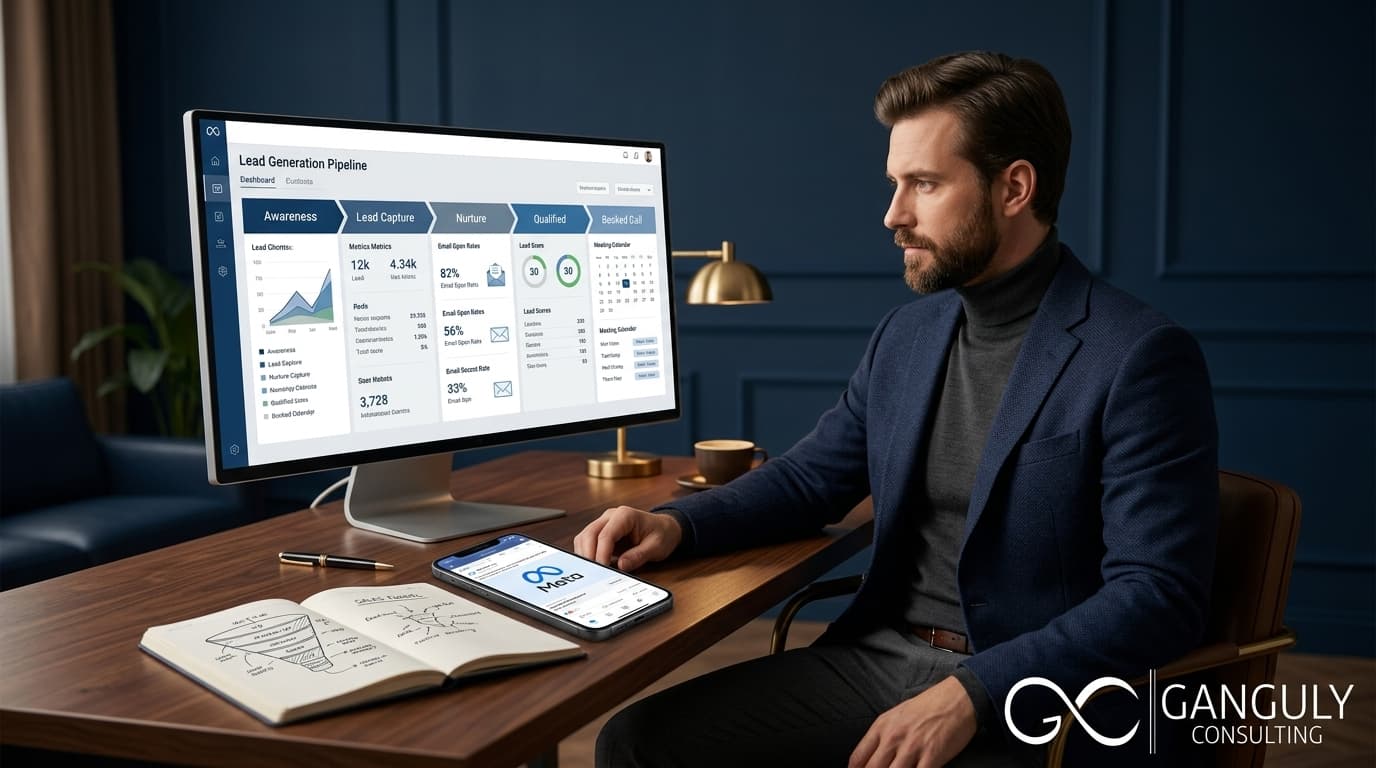
65% of businesses have no lead nurturing process. Here's how to build a referral-independent lead generation system that produces consistent, qualified leads every month.
How to Build a Lead Generation System That Doesn't Depend on Referrals
Most service businesses run on referrals. Not by choice, but by default. A client refers a colleague. That colleague refers someone else. Business is fine until it isn't — until a key referral source goes quiet, a long-term client moves on, or a slow quarter arrives and there's no system generating leads to fill the gap.
Referrals are a signal that your work is good. They're not a growth strategy. A referral-dependent business is a fragile business. When the referrals slow down, there's no lever to pull. No campaign to accelerate. No pipeline to review. Just waiting.
This post is about building the alternative: a lead generation system that runs independent of who you know, who refers you, and what happened last quarter.
Read more: Why Your Website, Ads, and CRM Need to Work as One System
Key Takeaways
- 65% of businesses have no lead nurturing process, meaning most inbound leads are lost after first contact (Sopro, 2025)
- CRM use boosts lead conversions by up to 300% — but only when connected to your traffic and capture layers (DemandSage, 2026)
- Multi-channel campaigns achieve 31% lower cost per lead than single-channel outreach (Sopro, 2025)
- A referral-independent system has four components: a visible presence, a traffic source, a conversion layer, and automated follow-up
- You don't need to replace referrals — you need a system that works whether they arrive or not
Why Referral Dependence Is a Structural Problem
Referral-dependent businesses aren't growing — they're surviving. According to Sopro (2025), 65% of businesses have no lead nurturing process in place. That statistic points to the same root cause as referral dependence: there's no system managing leads after the first contact. When a referral arrives, it works. When it doesn't, there's nothing running in its place.
The problem isn't that referrals are bad. They're efficient, high-trust, and usually close faster than cold leads. The problem is relying on them exclusively. A referral is a one-time event initiated by someone else. A lead generation system is a repeatable process you control. Those are fundamentally different things. One scales. One doesn't.
When business slows, the instinct is to reach back out to past clients, post more on social media, or spend money on an ad campaign. None of those work well in isolation because they're tactics without a system to support them. A post with no landing page generates awareness with nowhere to go. An ad with no follow-up sequence generates clicks that go cold.
Read more: The 5 Layers of a Digital Growth System Every Service Business Needs
Our observation: The businesses most dependent on referrals aren't the ones with the worst marketing. They're often the ones with the best reputations. Their work is excellent. Their clients trust them. But because the work speaks for itself, the system was never built. The referrals kept coming and the need for infrastructure never felt urgent — until it did.
What a Referral-Independent Lead Generation System Actually Is
A lead generation system is a connected set of components that produces qualified leads predictably. It has four parts. First, a visible presence: a website and positioning clear enough that a stranger — not someone who already knows you — understands exactly what you offer and who it's for. Second, a traffic source: a channel that actively brings qualified people to your offer, not one that waits for them to search you out. Third, a conversion layer: a landing page that captures leads with context and routes them into a CRM automatically. Fourth, automated follow-up: a sequence that contacts every lead within minutes and moves them toward a booked call without anyone manually checking an inbox.
Most service businesses have pieces of this. They have a website. They may have run ads. They probably have a CRM account. What they don't have is a system — the four pieces connected and working together as one process. Each piece alone does little. Connected, they produce leads consistently.
62% of customers will ignore a business without a clear web presence (Levitate AI, 2025). That's not just an argument for having a website — it's an argument for having a presence calibrated for people who don't already know you. A referral arrives pre-sold. A cold prospect needs a different kind of page.
Does Your Website Work for Cold Audiences?
Most service business websites are built for warm audiences. They assume the visitor already knows roughly what the business does and just needs confirmation that they're credible. That's fine for referrals. It does nothing for cold traffic.
A website built for cold audiences does three things differently. It answers "what do you do and who is it for" within the first five seconds — not after scrolling through a visual design showcase. It addresses the specific problem the prospect is experiencing, using their language, not industry language. And it gives them one clear action to take: book a call, fill out a form, download a resource.
62% of customers ignore businesses without a clear web presence (Levitate AI, 2025). The implication isn't just that you need a website. It's that the website needs to communicate clearly enough to a stranger that they stay, engage, and take action. Most service business sites fail this test because they were designed by a web designer optimizing for aesthetics, not a strategist optimizing for conversion.
In practice: When we review a new client's website, the first thing we test is whether a stranger can answer three questions within ten seconds: what does this business do, who is it for, and what should I do next? In most cases, the answer to all three is unclear. The homepage is built around the brand's story and services list — not around the prospect's problem and the solution they're looking for. That's the gap between a site that supports referrals and one that generates cold leads.
Read more: The 5 Layers of a Digital Growth System Every Service Business Needs
The fix isn't a full website rebuild. It usually starts with one landing page: a single page built around your primary offer, with a headline that speaks directly to the problem your ideal client has, a clear explanation of what you do about it, and one call to action. No navigation menu pulling attention elsewhere. No three competing offers. One page, one job.
Which Traffic Source Should You Start With?
Traffic is the component most service businesses skip to first — and most often get wrong. The question isn't which platform to use. It's which traffic source will send the right people to the right page fast enough to generate meaningful data.
Multi-channel campaigns achieve 31% lower cost per lead than single-channel outreach (Sopro, 2025). But multi-channel is a destination, not a starting point. Starting with two or three channels simultaneously splits your attention and makes it harder to learn what's working. The right starting point for most service businesses is one paid channel — validated, optimized, and producing data before adding a second source.
For service businesses targeting professionals and business owners, Meta ads are the most efficient entry point. The average CPL on Meta is $27.66 (WordStream, 2025). That's a relatively low cost to test whether your message lands with a cold audience and whether your landing page converts that traffic into leads.
Meta ads work as a starting point for a specific reason: they're a positioning test as much as a lead generation tool. If the ad doesn't generate clicks, the message isn't landing with the audience. If clicks don't convert on the landing page, the offer or the page needs work. If leads come in but don't respond to follow-up, the sequence needs adjusting. Each component surfaces problems in the others.
SEO and content are the second layer of traffic — slower to start but compounding in value over 12 to 18 months. They attract buyers who are actively searching for what you offer, which typically means higher intent and lower friction to close. A mature lead generation system runs both. A starting system picks one and builds from there.
Read more: Meta Ads + Landing Page + CRM: The Lead Gen Stack That Actually Works
How Do You Build a Landing Page That Converts Cold Traffic?
A landing page for cold traffic has a different job than a website homepage. It's not built for discovery. It's built for one decision: do I want what this page is offering, and am I willing to take this one action to get it?
Most service business landing pages fail because they carry too many ideas at once. There's a headline about the business's philosophy, followed by a list of services, followed by three testimonials, followed by a contact form. That's a homepage, not a landing page. A landing page answers one question — "is this the right solution for my specific problem?" — and gives the visitor one action to confirm their answer.
The structure that works for service businesses is straightforward. Open with a headline that names the problem precisely: not "we help businesses grow" but something like "you're getting referrals, but your pipeline isn't predictable." That specificity signals to the right person that this page is for them. Follow with two to three sentences explaining what you offer and what changes for the client. Then one form — name, email, and one qualifying question. Nothing else on the page.
According to WordStream's 2025 Facebook Ads Benchmarks, average Meta lead gen conversion rates sit around 7.72%. That number assumes message match between the ad and the landing page. When the ad and the page say the same thing to the same person, the decision to convert is already half made by the time they arrive.
Why Is CRM the Component Most Businesses Skip?
CRM is the layer that separates a lead list from a lead pipeline. Yet most service businesses treat it as an administrative tool — something to store contacts in, not something to close business with.
CRM use boosts lead conversions by up to 300% (DemandSage, 2026). That figure represents what happens when a CRM is connected to your traffic and conversion layers and is actively routing leads into follow-up sequences. It does not represent what happens when it's a spreadsheet you update manually.
The configuration that produces results is specific. Every form submission should create a CRM contact automatically, with the lead source tagged — which ad, which campaign, which audience segment. That context is what makes follow-up specific rather than generic. A follow-up that says "thanks for your interest in our services" converts at a fraction of the rate of one that says "you expressed interest in building a referral-independent pipeline — here's how we approach that."
Read more: Why 65% of Businesses Have No Lead Nurturing Process (And How to Build One)
Only 21% of marketing leaders can accurately measure their return on marketing investment (ResearchAndMetric, 2025). That gap exists largely because the CRM isn't connected to the traffic layer. Without source tagging, you can't trace which campaign produced which lead, which lead closed, and what that means for your next campaign's budget allocation. The CRM is the system of record for that data — if you set it up to capture it.
Our observation: The businesses that see the biggest lift from CRM implementation are rarely the ones that buy a more sophisticated platform. They're the ones that spend two hours configuring their existing CRM to automatically receive form submissions with source data attached. The technology is already there. The configuration isn't. That gap — not the tool itself — is what's costing them 300% in potential conversion rate.
What Does an Automated Follow-up Sequence Look Like?
65% of businesses have no lead nurturing process at all (Sopro, 2025). That means most leads — regardless of how well the ad performed or how well the landing page converted — go cold after the first contact. Not because the prospect lost interest, but because the business lost momentum.
An automated follow-up sequence is the component that keeps momentum without requiring manual effort. It fires from the CRM the moment a lead is captured and walks the prospect from initial interest to a booked call. It runs whether it's 9am on a Tuesday or 11pm on a Saturday. The lead doesn't wait until someone checks their email in the morning.
The minimum viable sequence for a service business has three steps.
Email one, within five minutes of form submission. Acknowledge what they expressed interest in and set expectations for next steps. Keep it short — three to four sentences. Add one piece of useful context: a relevant case study, a short video, or a single insight that demonstrates you understand their situation. Not a sales pitch. A relevance signal.
Email two, 24 to 48 hours later. One specific follow-up: a resource related to the problem they have, or a direct question about their situation. Something that requires a response, even a short one. Conversation is the goal. Silence means you haven't said anything worth responding to yet.
Email three, day five. A direct, low-pressure close: "Are you still looking for help with X? Happy to set up a 20-minute call this week to talk through whether we're a fit." Specific. Easy to respond to. No pressure language.
Three emails. Automated. Running without anyone touching them. That's the difference between a business that converts 2% of its leads and one that converts 8%.
Marketing automation delivers 544% ROI over three years (Thunderbit, 2026). The foundation of that number isn't sophisticated AI personalization or complex branching logic. It's this: a lead submits a form, the CRM fires a relevant email within minutes, and a simple sequence runs from there. The lift comes from speed and consistency — not complexity.
How Do You Put It All Together?
Here's how the four components work as one system, step by step.
Step 1: Build your positioning and primary offer. Before a landing page or an ad, get clear on one statement: "We help [specific client type] who are experiencing [specific problem] achieve [specific outcome] through [your approach]." That statement drives every other element of the system. It's the message in the ad, the headline on the landing page, and the context in the follow-up sequence.
Step 2: Build one dedicated landing page. Not a homepage refresh. One page, built specifically for paid traffic. Headline that names the problem. Two to three sentences about your solution and the outcome it delivers. One form: name, email, one qualifying question. No navigation menu. No other links. One job.
Step 3: Connect the form to your CRM automatically. Use a native integration or Zapier. Add a hidden UTM field to capture the source of every lead. Every form submission creates a CRM contact tagged with the campaign, ad set, and ad creative that produced it. This happens without anyone touching it.
Step 4: Write and activate three follow-up emails. Load them into your CRM's automation. Email one fires within five minutes of form submission. Email two fires on day two. Email three fires on day five. Each one is short, specific, and adds something useful. The sequence runs without manual input.
Step 5: Launch one paid traffic campaign. With the conversion infrastructure in place, start the ad. Start conservatively — $20 to $30 a day is enough to generate data. Run for two to three weeks before making changes. Watch three numbers: click-through rate (is the ad message landing?), landing page conversion rate (is the offer compelling?), and follow-up response rate (is the sequence relevant?).
Step 6: Set up one reporting dashboard. Track leads generated, conversion rate, and follow-up responses weekly. These three numbers tell you where the system is working and where it needs adjustment. Only 21% of marketing leaders can accurately measure ROI (ResearchAndMetric, 2025). Having these three metrics visible puts you ahead of the overwhelming majority.
That's the system. Six steps. Most service businesses can have a basic version operational within two weeks.
What Happens When You Run Both Systems at Once?
Referrals don't stop when you build a system. They continue — and the system makes them more valuable.
When a referral arrives and you have a functioning lead generation system, the referral enters the same infrastructure. They see a landing page that clearly explains your offer. They receive the same automated follow-up sequence. Their data is captured in your CRM. Nothing is lost to manual handling or a forgotten email.
More importantly, you're no longer dependent on them. A week with no referrals isn't a slow week — it's a week where the ads and the sequence are still running. The referral, when it arrives, is a bonus rather than a lifeline.
The businesses that grow most consistently from referral-dependent to system-driven don't abandon referrals. They build the system in parallel, test it until it works, and then scale the spend once the conversion infrastructure is proven. The system doesn't replace the relationship-driven part of the business. It fills the gaps between the relationships.
Multi-channel campaigns achieve 31% lower cost per lead than single-channel outreach (Sopro, 2025). When referrals and paid systems run simultaneously, you're running multiple channels. That's not an accident. It's what a mature lead generation system looks like.
Read more: Why Your Website, Ads, and CRM Need to Work as One System
Frequently Asked Questions
How long does it take to build a referral-independent lead generation system?
For a service business starting from scratch, a basic system — one landing page, one CRM with source tagging, one three-email follow-up sequence, and one active ad campaign — can be operational in two to three weeks. The longest component is typically the landing page copy and the follow-up email writing. The technical setup (form-to-CRM integration, UTM tracking, email automation) is usually one to two days of focused work. You don't need a large team or an expensive tech stack to get started.
What is the minimum budget needed to run a Meta ads lead generation system?
The minimum viable budget for testing is $20 to $30 a day ($600 to $900 a month). That's enough to generate meaningful data on whether your message is landing, whether your landing page is converting, and whether the leads you're attracting are the right fit. The average CPL on Meta is $27.66 (WordStream, 2025), so a $600 monthly budget should generate 20 to 30 leads at baseline. That's enough to validate or adjust the system before scaling.
Why don't cold leads convert as well as referrals?
Referrals arrive pre-sold. They already trust you because someone they trust vouched for you. Cold leads don't have that context, so they need a different kind of conversion path: a specific message that speaks to their problem, a clear offer, and a follow-up sequence that builds relevance before asking for a meeting. The gap isn't that cold leads are lower quality. It's that most businesses use the same follow-up process for cold leads that they use for referrals — which is no process at all. CRM use boosts lead conversions by up to 300% (DemandSage, 2026), and most of that gain comes from building context-specific follow-up for leads who didn't already know you.
Do I need a CRM to run a lead generation system?
Not a sophisticated one — but you need something. The minimum is a system that automatically receives form submissions, stores lead source data, and can trigger an automated email sequence. HubSpot's free tier, GoHighLevel, and ActiveCampaign all do this and all have native or Zapier-based integrations with Meta Lead Ads. The tool matters less than the configuration: source tagging on every lead, automatic entry on form submission, and automation that fires a follow-up sequence without manual input. 65% of businesses have no lead nurturing process in place (Sopro, 2025) — having any automated follow-up puts you ahead of most of the market.
How do I know if my lead generation system is working?
Track three numbers every week. First: lead volume from paid traffic — how many leads did the system generate this week? Second: landing page conversion rate — what percentage of visitors who clicked the ad filled out the form? Third: follow-up response rate — what percentage of leads replied to the automated sequence? When all three are visible and moving in a consistent direction, the system is working. When one stalls, that's where to focus. Only 21% of marketing leaders can accurately measure marketing ROI (ResearchAndMetric, 2025) — having these three metrics in one place is a meaningful competitive advantage.
Stop Waiting. Build the System.
There's nothing wrong with referrals. The problem is the posture they create: a business waiting for the next one to arrive, with no lever to pull when it doesn't. That posture doesn't change until a system exists that generates leads independent of who happens to recommend you this month.
The system isn't complex. A clear landing page, a connected CRM, three automated emails, and one active traffic channel. Those four components, working together, produce leads that don't depend on relationships, timing, or luck. They depend on infrastructure.
Most service businesses already have the pieces. They have a website, an ad account, and a CRM. What they don't have is the configuration that makes those pieces work as one system. The gap between the tools and the system is an afternoon of setup work. It's not a budget problem or a technology problem. It's a priority problem.
Marketing automation alone delivers 544% ROI over three years (Thunderbit, 2026). That return doesn't come from complexity. It comes from consistency — from a system that runs the same follow-up process for every lead, every time, without anyone remembering to do it.
Build the system once. Then let it run.
Read more: Meta Ads + Landing Page + CRM: The Lead Gen Stack That Actually Works
Abhisek Ganguly is the founder of Ganguly Consulting, a premium tech and growth consulting firm that helps service businesses build integrated digital growth systems. Ganguly Consulting works at the intersection of technology, marketing, and business strategy.