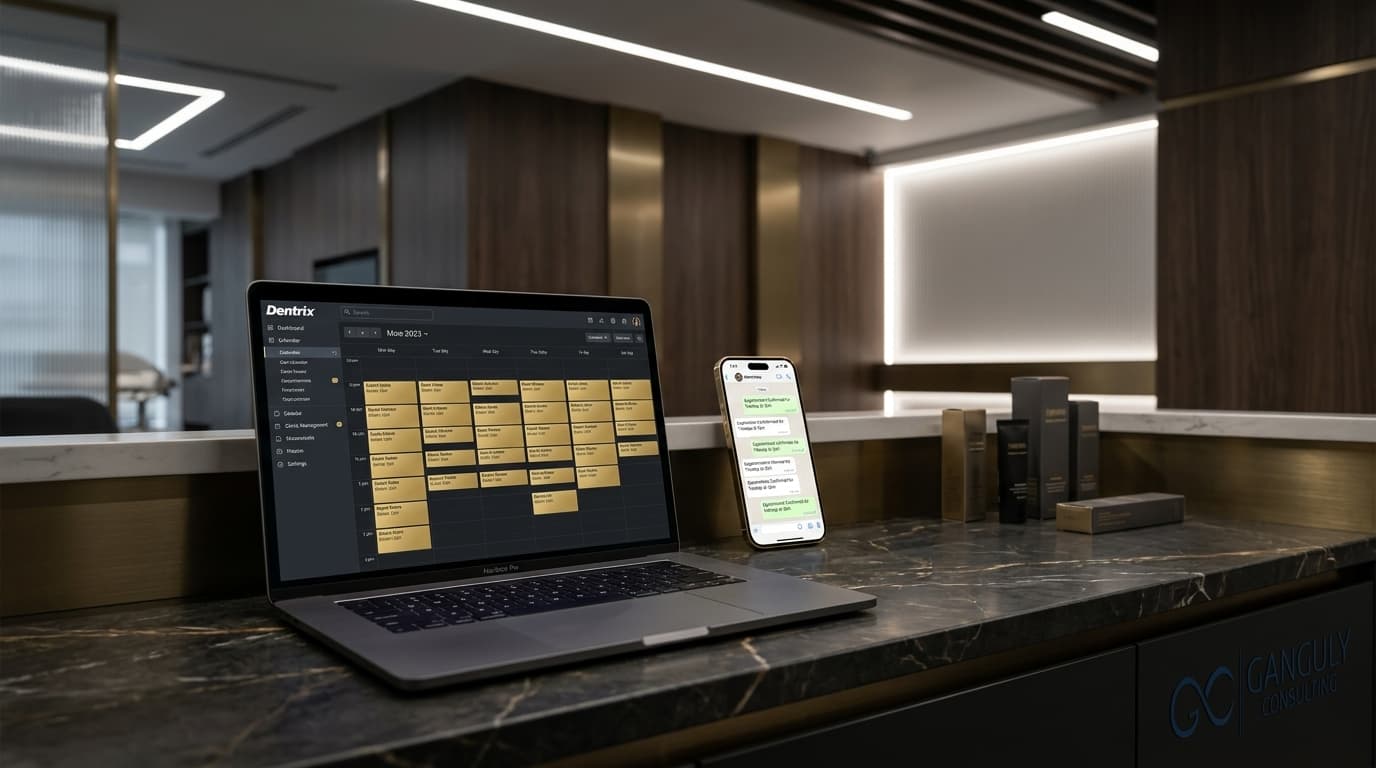
77% of patients search online before booking a clinic appointment — but most clinics have no system to capture that traffic. Here's the integrated patient acquisition approach that consistently delivers 5–10x returns on marketing spend within one quarter.
How Clinics Are Filling Their Calendars With New Patients Within 90 Days (Without Relying on Word of Mouth)
A dental clinic spending ₹40,000–₹1,00,000 per month on marketing and seeing empty mid-week slots is not a marketing spend problem. It's a systems problem. The marketing exists. It isn't connected.
77% of patients now begin their search for a healthcare provider on Google (NetOneClick, 2024). 84% check online reviews before choosing a clinic (rater8, 2025). 61% trust those reviews more than personal recommendations from friends (rater8, 2025). The patient decision has already moved online — and most clinics are invisible at the moment it's being made.
The clinics that are fully booked three months after implementing a patient acquisition system didn't find some secret channel. They connected three things that most clinics have running independently: social presence, local search, and paid advertising. When these three components feed each other — and when WhatsApp automation handles appointment reminders and re-engagement — the system produces a consistent flow of new patients without a single referral required.
This post breaks down what that system looks like, where most clinics are losing patients before they ever make contact, and what a 90-day build actually produces.
Key Takeaways
- 77% of patients start their healthcare search online — 93% of that discovery happens on Google (Healthcare Marketing Statistics, 2025)
- 84% of patients check online reviews before choosing a provider — 61% trust them more than personal recommendations (rater8, 2025)
- WhatsApp appointment reminders reduce no-show rates by 35–60% — with a 98% open rate and 90% read within 3 minutes (Happoin, 2025)
- Clinics combining PPC and local SEO see 47% improvement in patient volume (Birdeye, 2025)
- The average cost to acquire a new dental patient via ads is ₹1,200–₹2,500 — a patient worth ₹5,000–₹10,000 in first-year spend
Why Most Clinics Are Invisible to the Patients Looking for Them Right Now
The conventional clinic marketing strategy is referrals and word of mouth. Build a good reputation, treat patients well, and they send their friends. This works — slowly, unpredictably, and with no control over volume or timing.
The problem isn't that word of mouth is bad. It's that it accounts for an increasingly small percentage of how patients actually find clinics. When someone has a toothache on a Tuesday, they don't call a friend. They open Google and type "dentist near me." They look at which clinics appear, how many reviews they have, what their rating is, and whether the profile looks complete. They pick one of the top three. The entire decision happens in under 90 seconds.
If your clinic isn't in those top three results — on Google Maps, in local search, and in the Instagram and Facebook feeds of people in your area — you don't exist in that decision. It doesn't matter how good your dentistry is.
What's actually happening in most clinics:
Most clinics have a Google Business Profile that was set up once and never updated. Photos are from 2019. The service list is incomplete. There's no weekly post, no review generation system, and no strategy for the Q&A section that Google surfaces to potential patients.
Most clinics have an Instagram account. It gets posted to when someone remembers, with photos taken on a phone with inconsistent lighting. There's no content strategy, no consistent posting schedule, and no link to an appointment booking mechanism.
Most clinics running Meta ads are boosting posts — the lowest-efficiency ad format — or running campaigns that send traffic to their homepage instead of a dedicated booking page. The lead, if they click, arrives at a generic "welcome to our clinic" page with six menu items and a phone number.
None of these components is the problem. The absence of connection between them is.
Our observation: When we audit a clinic's digital presence, the most common gap isn't the absence of marketing — it's the absence of conversion at every step. The Instagram account has 400 followers but no link to book. The Google Business Profile has 12 reviews but the listing says "no website." The Meta ad is running but sending traffic to a page that takes 8 seconds to load on mobile. We've seen clinics with perfectly good individual components that are generating almost no new patients, because nothing is designed to close. The system question isn't "are we doing marketing?" — it's "is any of it actually converting?"
The Three Channels Every Clinic Needs — And Why They Only Work Together
Channel 1: Google My Business — where 93% of healthcare discovery happens.
93% of healthcare discovery occurs on Google search (Healthcare Marketing Statistics, 2025). When someone searches "dentist near me" or "dental clinic in [your area]," Google Maps results appear above organic results. The clinics that appear in the top three positions receive the overwhelming majority of clicks.
Getting into those top three positions isn't luck. It's a function of how complete your Google Business Profile is, how many recent reviews you have, how consistently you post updates, and how well your service categories match the search terms people are using. A clinic with a fully optimized Google Business Profile receives 5–12x more calls than one with a sparse or unmanaged listing (Birdeye, 2025).
Reviews are the highest-leverage element. 73% of patients rely on online reviews as the first step in selecting a provider (WG Content, 2025). 80% consider providers with five or more reviews to be trustworthy. A clinic going from 8 reviews to 40 reviews — all four-star or above — typically sees a measurable increase in inbound calls within 30–60 days. The reviews don't need to be from dozens of new patients. They come from the existing patient base, who will leave a review if someone makes it easy to do so.
Channel 2: Instagram and Facebook — the trust layer between discovery and booking.
When a patient finds your clinic on Google, the next thing they do is look you up on social media. They want to know if this is a real clinic with real people, what the environment looks like, whether the doctor seems approachable. Instagram and Facebook are not primarily lead generation channels for a local clinic. They're credibility channels.
A clinic with an active, professional Instagram account — consistent posts, photos of the team and clinic environment, patient education content, real results with consent — converts at a substantially higher rate from the patients who discover it via Google or ads. They've seen the clinic before they walk in. The unknown quantity is gone.
Social is also a referral amplifier. When an existing patient tags the clinic in a post or shares a story, their network of local connections sees it. That's organic reach to a pre-qualified audience — people who live near your clinic and trust the person sharing.
Channel 3: Meta Ads — the fastest path to new patient inquiries.
Google My Business and social build foundation and trust. Meta Ads produce new patient inquiries within 24–72 hours of a campaign going live. They are the accelerant.
A well-structured Meta campaign for a dental clinic targets people within a specific radius — your actual catchment area — with a specific treatment offer or appointment hook. Not a generic "we're a dentist" ad. Something specific: a whitening treatment promotion, a new patient examination offer, a clear explanation of one service the clinic wants to grow.
The campaign sends traffic to a dedicated booking page — not the clinic homepage — with one clear action: book an appointment or submit an inquiry. The cost per new patient inquiry via Meta, properly structured, runs between ₹800–₹2,500 for most Indian urban markets. A patient who books and attends is worth ₹5,000–₹15,000 in first-year treatment spend, often more. The return on each acquired patient dwarfs the acquisition cost.
The No-Show Problem: How WhatsApp Automation Changes the Math
Acquisition is only half the equation. A clinic that acquires 20 new patient inquiries per month but has a 30% no-show rate is effectively acquiring 14 patients. The budget spent acquiring the missing six was wasted.
WhatsApp appointment reminders reduce no-show rates by 35–60% (Happoin, 2025). WhatsApp messages have a 98% open rate, with 90% read within three minutes of delivery. Compare that to email (20–30% open rate) or a phone call that goes to voicemail — and the operational logic is clear.
A clinic sending automated WhatsApp reminders 24 hours before and 2 hours before each appointment sees no-show rates drop from a typical 20–30% to 8–12%. On a 100-appointment month, that's 10–20 more attended appointments — without acquiring a single additional patient. The revenue impact of those recovered appointments typically equals or exceeds the monthly marketing spend.
The re-engagement sequence is equally powerful. Patients who visited 6–12 months ago and haven't returned are not gone. They're dormant. A single WhatsApp message — "It's been a while since your last visit. We'd love to check in. Here's a link to book" — re-activates a meaningful percentage of the dormant patient base. These patients have zero acquisition cost. Every reactivated appointment is pure margin.
The 90-Day Build: What Actually Happens Month by Month
Month 1: Infrastructure and Visibility
Week 1–2: Full Google Business Profile audit and optimisation. Correct categories, complete service list, updated photos, Q&A populated with the questions patients actually search. A review generation process is set up — a simple WhatsApp message sent to every patient after their visit with a direct link to leave a review. Target: 10–15 new reviews in month one.
Week 3–4: Social media content calendar built for the next 60 days. 12–16 posts per month across Instagram and Facebook — clinic culture, team introductions, patient education, treatment spotlights. First Meta campaign launched targeting a specific treatment with a dedicated booking landing page.
WhatsApp Business set up with automated reminder sequences: 24 hours before appointment, 2 hours before appointment. Re-engagement sequence built for patients inactive for 6+ months.
Month 2: Traffic and Conversion
Meta campaigns are now generating inquiries. The review count is visibly climbing. Social posts are building a consistent presence in the feeds of people within the clinic's area.
Focus shifts to conversion. The landing page is tested and refined — headline, form length, trust signals. A second Meta campaign targets a different treatment or a retargeting audience of people who visited the booking page but didn't submit. Google Business Profile is receiving weekly posts, and the review response rate is maintained (responding to every review, positive or negative, within 24 hours).
Month 3: Optimization and Scale
By day 60–70, the system has data. Which Meta campaign is generating the most booked appointments. Which content format on social is driving the most profile visits. How many reviews have been collected and what the new local ranking position looks like.
Double down on what's working. Scale the Meta campaign generating the most appointments. Increase posting frequency on the format performing best. Expand the WhatsApp automation — add a post-treatment follow-up message, a birthday message, a recall reminder at the 6-month mark.
Clinics running this full system — all three channels connected, WhatsApp automation in place — typically see 10–20 new patient inquiries per month by the end of month two, and 15–30 by the end of month three. Google ranking in the top three for primary search terms within 60–90 days. No-show rates at 8–12%. Returning patient rate up from WhatsApp re-engagement.
What Makes This Different From What Most Clinics Are Already Doing
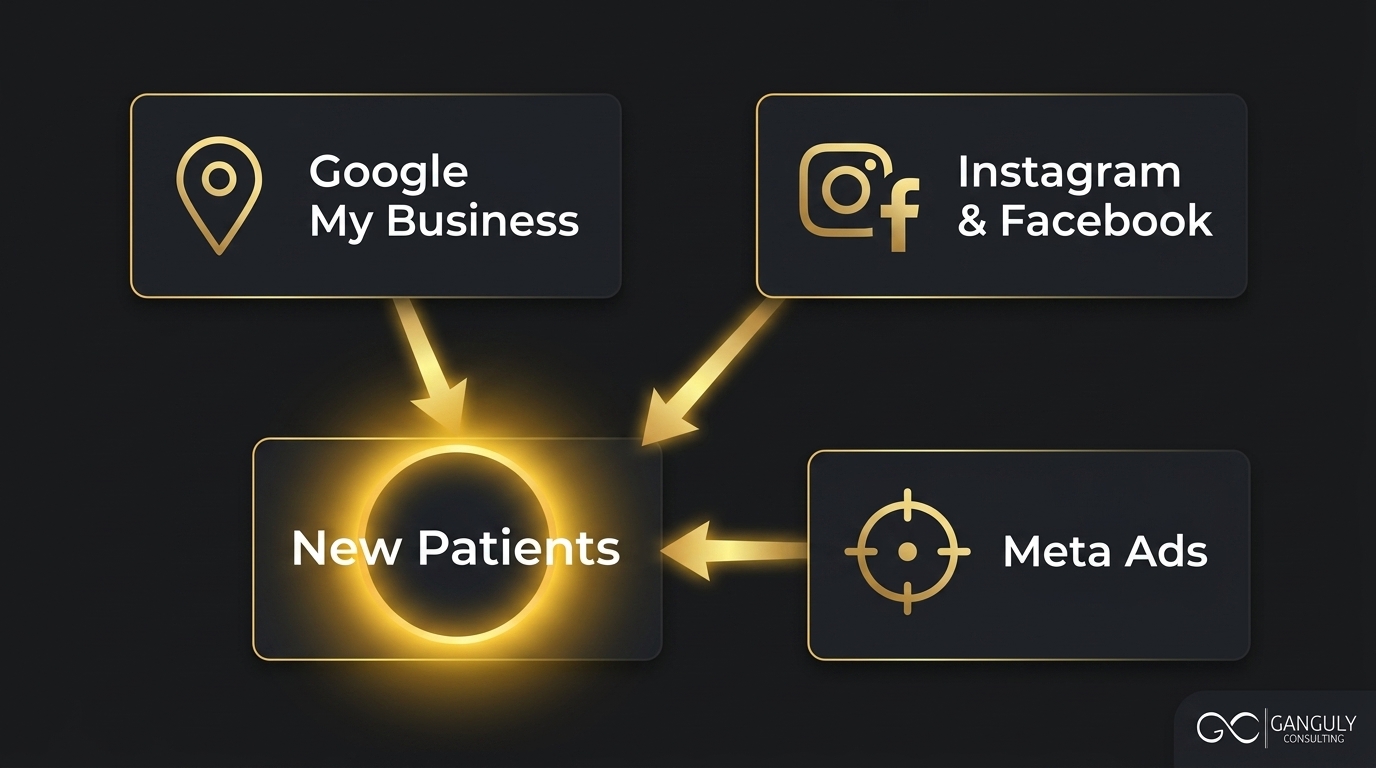
Most clinics have individual tactics, not a system. The difference is specific and measurable.
A tactic: Boosting an Instagram post to reach more people. The system equivalent: Running a structured Meta campaign targeting people within 5km of the clinic, sending traffic to a dedicated booking page, with a WhatsApp inquiry response triggered within 5 minutes of form submission.
A tactic: Asking happy patients to leave a review when they happen to mention it. The system equivalent: A WhatsApp message sent to every patient 2 hours after their appointment with a direct link and a two-sentence ask, generating 8–15 reviews per month on autopilot.
A tactic: Posting clinic photos on Instagram when someone remembers. The system equivalent: A 30-day content calendar built around specific content pillars — team trust, patient education, treatment spotlight, social proof — posted on a consistent schedule that builds familiarity in the feeds of people in the clinic's area.
The individual tactics exist in most clinics. The connected system doesn't. And that's why most clinics have a social account, a Google listing, and occasional ads — but not a calendar full of new patients.
The ROAS Reality for Clinic Marketing
The return on a connected clinic marketing system is straightforward to model.
Average cost to acquire a new dental patient via ads: ₹1,200–₹2,500 (urban Indian markets, Meta campaigns with dedicated landing pages).
Average first-year patient spend: ₹5,000–₹15,000 depending on treatment mix.
ROAS on acquisition alone (conservative): 3–5x.
Add in lifetime value — a patient who stays, refers family members, and returns annually — and the LTV of an acquired patient over three years is ₹15,000–₹50,000. Against an acquisition cost of ₹1,500–₹2,500, the system ROAS over the patient relationship is 10–20x.
Add in the WhatsApp no-show reduction: A clinic seeing 15 no-shows per month, averaging ₹2,500 per appointment, loses ₹37,500 in monthly revenue to no-shows. Reducing that to 6 no-shows saves ₹22,500 per month — more than most clinics spend on their entire marketing budget. The WhatsApp automation alone pays for the system many times over.
Add in re-engagement: A re-engagement campaign sent to 200 lapsed patients with a 15% response rate generates 30 booked appointments at zero acquisition cost. At ₹2,500 per appointment, that's ₹75,000 in revenue from a single WhatsApp broadcast.
The math consistently puts well-run clinic marketing systems at 5–10x ROAS within 90 days, and 10x+ once patient lifetime value and re-engagement revenue are included.
Frequently Asked Questions
How much should a dental clinic spend on marketing per month?
The right marketing budget depends on the clinic's scale and growth goals, not a fixed percentage. A single-chair clinic in a mid-tier city might run an effective system for ₹25,000–₹40,000 per month (management fee plus ad spend). A multi-chair clinic in a metro area targeting faster growth might invest ₹75,000–₹1,50,000 per month. The more important question is not what to spend, but what system that spend is being put into. ₹20,000 in a connected system (GMB + social + targeted ads + WhatsApp) produces measurably better returns than ₹80,000 in disconnected boost campaigns.
How long before we see new patient inquiries from a Meta campaign?
A properly structured Meta campaign targeting people in your area with a specific treatment offer and a dedicated booking page generates inquiries within 24–72 hours of launch. The first two weeks are typically the lowest-performing as the Meta algorithm learns your audience. By week three, the campaign is optimized and inquiries are consistent. The critical element is the landing page — campaigns sending traffic to a homepage rather than a dedicated page will see significantly lower conversion rates.
Does Google My Business actually drive new patients, or is it just for reputation?
Both — and the two are connected. An optimized Google Business Profile with recent reviews and consistent posts drives direct inbound calls from people searching "dentist near me." It also improves organic ranking so your clinic appears in local map results. Clinics with fully optimized profiles receive 5–12x more calls than sparse listings. And those reviews are read by patients who found you via Meta ads or social — increasing the conversion rate from every other channel. GMB is not optional for a local clinic growth system.
We already have a social media account — do we need to rebuild it?
Not necessarily. An existing account with some history is an asset. What typically needs to change is the content strategy — moving from ad-hoc posting to a planned content calendar — the posting frequency, the quality of visuals, and the addition of a booking link or mechanism. The account doesn't need to be rebuilt; the strategy needs to be rebuilt around it.
What results should we realistically expect in the first 90 days?
Based on the clinics Ganguly Consulting has worked with: 10–20 new patient inquiries per month by the end of month two. Google ranking in the top three for primary local search terms within 60–90 days (depending on current competition and starting point). No-show rate reduction of 30–50% once WhatsApp reminders are active. 15–25 new Google reviews collected in the first 60 days via a structured review generation process. Revenue from re-engaged lapsed patients, typically within the first 45 days of WhatsApp automation being live.
These are outcomes from running all three channels in an integrated system — not from running any single component in isolation.
A Full Calendar Is Not an Accident
The clinics that are fully booked didn't achieve it through word of mouth alone or lucky timing. They built a system where new patients find them at the moment of search, trust them when they check social, convert when they see an ad, show up because WhatsApp reminded them, and come back because the system stayed in contact.
Word of mouth is valuable. It's not controllable, scalable, or immune to a competitor opening across the street with a better Google presence and a more active Instagram account.
A connected patient acquisition system is all three. It runs consistently, it compounds over time as reviews accumulate and content builds recognition, and it gives you visibility into exactly where each new patient came from and what acquiring them cost.
That visibility is the foundation of every growth decision. You can't grow what you can't measure, and you can't improve what you can't see. The system makes both possible — and a full calendar is the natural result.
Read more: The Complete Guide to Building a Digital Growth System for Service Businesses
Abhisek Ganguly is the founder of Ganguly Consulting, a premium tech and growth consulting firm that helps clinics and service businesses build integrated digital growth systems. Ganguly Consulting works at the intersection of technology, marketing, and business strategy.